Episode 1 · October 10, 2026
Georgina Kelly: From the City of London to Ras Al Khaimah
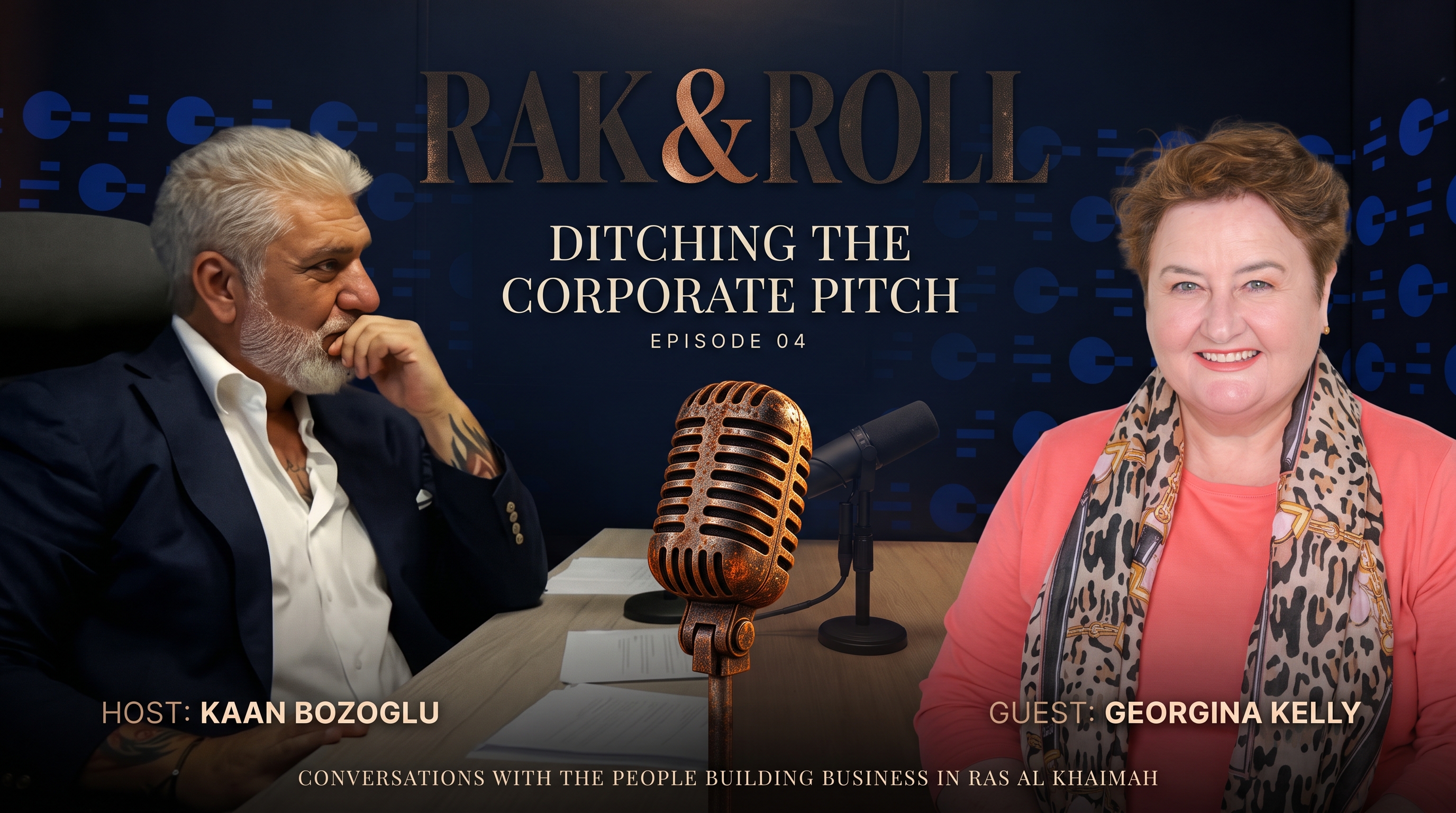
Georgina Kelly shares how she built a business in the UAE, changed her London approach, held her price, and found a new direction in Ras Al Khaimah.
Watch the episode
Episode overview
The conversation
Georgina Kelly started her first business in recruitment in the City of London in the 1980s. She later co-founded Creative Intelligence with her husband, David Learman, combining his design expertise with her business development experience.
In the 1990s, she began researching the Gulf, meeting business owners and booking appointments with bank general managers by fax before she landed. In 2002, they moved their corporate and brand identity agency to Dubai.
In the first episode of RAK & ROLL, Georgina joins Kaan Bozoglu at Innovation City to discuss what changed when she brought her London approach to the UAE. She explains why she dropped her presentation slides, changed her language and made the meeting a conversation.
They explore pricing pressure, moving to Ras Al Khaimah out of necessity, finding balance and starting again as a trainer. Georgina also shares why she created RAK Entrepreneurs and why small business owners need to keep investing in their knowledge.
- Business
- RAK Entrepreneurs Business Forum
- Field
- Business Networking and Growth Organization
- Location
- Al Hamra, Ras Al Khaimah, United Arab Emirates
- Official website
- Visit business website
Key takeaways
What stands out
- Research the market before you try to sell in it.
- Understand your audience, competitors and the economic forces affecting their business.
- Adapt your language and approach to the people in front of you.
- Explain the knowledge and experience behind your price.
- Build a business model that fits your audience and your overheads.
- Treat learning as an investment in yourself and your team.
- Seek honest advice from people you trust.
In this episode
What we discussed
Starting a recruitment business in the City of London.
Building Creative Intelligence with David Learman.
Choosing the Gulf as an emerging market.
Research, embassy support, and meetings arranged by fax.
Replacing the London presentation with a conversation.
Responding to requests for the “Dubai price.”
Moving to Ras Al Khaimah and recovering work-life balance.
Winning a first sales training client.
Protecting intellectual property in white-label training.
Creating RAK Entrepreneurs to help SMEs develop their skills.
Resilience, self-awareness and advice that still holds after decades in business.
Marketing
Marketing discussion
Georgina describes an approach built on research, focus and understanding the client’s business. She chose banking and hospitality because she already knew those sectors, then explored their challenges before offering a solution.
When the terminology and presentation style she used in London did not connect in the UAE, she changed her words and dropped the slides. The meeting became a conversation that helped clients understand the value of corporate and brand identity.
The discussion also covered defending a price through expertise, choosing a clear audience, and designing an affordable training model around SME needs.
Local context
Ras Al Khaimah and the UAE
Georgina’s move to Ras Al Khaimah began as a practical response to financial pressure. Living in RAK and commuting to Dubai helped her and David reclaim their weekends and find a different balance.
That change also gave her space to reconsider her own work. She moved into business mentoring and training, then created RAK Entrepreneurs after observing gaps in the skills and communication of local SMEs.
The conversation explores the opportunities RAK’s development brings and why local businesses need to prepare for competition by investing in themselves and their teams.
Key moments
Chapters
- Welcome to RAK & ROLL
- 2:04 Starting out: recruitment in the City of London
- 3:16 Meeting David and founding Creative Intelligence
- 6:04 Why the Middle East over Europe
- 8:52 Research before selling: embassies, networks and trust
- 12:08 Gravitas, faxes and meetings booked before landing
- 13:52 What failed? London habits vs the UAE
- 15:24 Why being Irish helped in the UAE
- 22:24 The first pitch: predicting the bank mergers
- 48:32 Starting over: mentoring and the first training client
- 55:32 From training to RAK Entrepreneurs
- 1:04:24 Why RAK Entrepreneurs exists: upskilling SMEs
- 1:20:44 The biggest misconception about the UAE
- 1:24:56 Business advice that still holds after 20 years
- 1:29:08 Where to find Georgina
Transcript
Full conversation transcript
Cleaned transcript · EN
RAK & ROLL Episode 1: Georgina Kelly, Full Transcript
Oct 10, 2026 · @Caan
Kaan Bozoglu talks with Georgina Kelly, founder of RAK Entrepreneurs, about building businesses in London, Dubai and Ras Al Khaimah. Recorded at Innovation City, Ras Al Khaimah. Running time 89:41.
This transcript is lightly edited for reading: false starts, repeated words and filler are removed, and the meaning stays as spoken. Timestamps mark the start of each chapter.
00:00 Welcome to RAK & ROLL
Kaan: Hi guys, this is Kaan Bozoglu. We are at Innovation City, and we are starting the RAK & ROLL podcast. This is the first episode, and in the first episode we have Georgina with us. We're going to interview her, interrogate her and find out all of her secrets.
But what we want to do is not a brochure thing. I want to talk to the business owners in Ras Al Khaimah who have stories, and see what they faced, how they succeeded, where they failed. It's not an interview, it's more like a conversation. Hi, Georgina.
Georgina: Hi Kaan, thank you for inviting me to meet you again today.
Kaan: Thank you. Georgina is one of the people I have known the longest in the UAE, and she has helped me a lot in so many things. She runs RAK Entrepreneurs, a business community, and she will explain it better for you. She also teaches, she does consultancy work, and she has a long history in the UAE. So let's start. I prepared a lot for Georgina.
01:24 Starting out: recruitment in the City of London
Kaan: Georgina, before RAK, before even the UAE, how did you start your business life, and where? What did you do, and what drew you to it?
Georgina: Okay, we're going to go back a few decades.
Kaan: Only a decade.
Georgina: Oh yeah, a decade. Well, let the people decide for themselves. My first business was in London, on my own, in recruitment. I was working in the City of London, in the financial district.
Kaan: That must have been fun.
Georgina: A lot of fun. I loved it. This was in the 80s, and it was fun in many, many ways. I was very fortunate to be around at that time. I was very young, extremely young. I went into the recruitment industry and found out I was very good at it, because I'm fascinated with people and why they do things. And I'm also fascinated by business. So marry those two together and it works.
Then I decided to start out on my own. I was dealing with people working in commodity brokers and the banks.
Kaan: Was it freelance?
Georgina: No, no. This was full time, with a trade licence. We also had to be regulated by the Department of Trade and Industry, because when you recruit people for top-class jobs, they have to meet certain criteria. You have to make sure they're British, or if they're coming from Commonwealth countries, that they have the right paperwork. You have to dot the i's and cross the t's, because the Department of Trade and Industry, the DTI, would come and do an inspection once a year, at any time, without notice. So you really had to have your paperwork in order. Highly, highly regulated. Anyway, I loved that. I really did.
03:16 Meeting David and founding Creative Intelligence
Georgina: Then I met somebody who I ended up marrying.
Kaan: Oh my God.
Georgina: Yes, but he was a client first. And the amazing thing is, I had a rule: never go out with a client. He wasn't my client. He was a client of a member of staff. I just happened to meet him one evening, I was introduced, and there was magic there. Thirty-eight years later, we're still together.
Now, David decided to set up a business, and he asked me if I would join him.
Kaan: In the UK?
Georgina: We're still in London, and we're still in the 80s. David is a qualified designer. He was in the graphic design industry as a partner, specialising in corporate and brand identity projects, also in the City of London. So I understood the City boys very, very well. David said, we need somebody on business development, will you do it? And I said yeah, sure, I've been in recruitment.
Kaan: Maybe he was trying to pick you up.
Georgina: No, no, no. It was strictly professional. And that's how Creative Intelligence was formed, with both of us as partners. He looked after operations and the design side, and I looked after business development.
I found it easy. I said to him, right, you've got to teach me what corporate and brand identity is. It's a massive subject. So he spent an entire weekend teaching me what it's all about, because I needed to understand it. What is it, why would you have it, what are the benefits, how is it used, who needs it, who doesn't. It was a really interesting way to learn, because I was asking questions, and when I flipped them around, I was answering them for other people.
So we started working. In fact, I would walk into clients and tell them, I'm quite new to corporate and brand identity, because I believe in integrity and being honest. I find that when I'm honest, I win people over much quicker. They'd say, thank you very much for your honesty. And I'd say, but I do understand your business. I understand commodity brokers, I understand investment banking, I understand insurance, I understand the different divisions and what they do. I understand the Bank of England and its processes. So once I find out what your problems are, I can see whether what we do could solve them. And if it can't, that's fine.
06:04 Why the Middle East over Europe
Georgina: So that was the first business, David and I, and then we took that business from London to Dubai in 2002.
Kaan: What was the reason behind that? You could have gone to France, you could have gone to Germany.
Georgina: Okay, go back in time now. It depends how old your audience is, but some might remember what was going on in Russia at the time, and in Germany. The Wall had just come down in Berlin.
Kaan: That's '92, right?
Georgina: We're in '92. You had Gorbachev opening up Russia, the former USSR, and the Wall had come down. Our competitors had much deeper pockets than us, and they were walking into Eastern Europe, doing very well and winning a lot of business. They were also winning a lot of business in the UK. It was tough for us as a brand new startup. We came from the same kind of background, the same design stable, so the designers had the experience. But when you're the new kid on the block, it's tough.
I said to David, we need to look at emerging markets. We chose the Middle East because, when I did my research on emerging markets and looked at the Far East, business at the time was done in the language of the country. In the Middle East, business was primarily done in English.
Kaan: Arabic wasn't the primary language?
Georgina: Not for business. You can imagine why. Look at how many nationalities are here.
Kaan: It's very cosmopolitan.
Georgina: Exactly. It wasn't as cosmopolitan at the time, but it was certainly heading that way. A lot of people, even from the Indian subcontinent, didn't speak fluent Arabic.
Kaan: So English was basically the language.
Georgina: Exactly. So I came out here and did some research. There was a thing called the Britain in the Gulf exhibition, and I thought, right, I'm going to go out and do my research while that's on, because I can speak to a lot of companies in different business sectors at one time and find out what it's like doing business, what the culture is like, this, that and the other. I spent my days going around talking, because most of the ladies and gents at the exhibition owned their own businesses.
08:52 Research before selling: embassies, networks and trust
Kaan: I want to ask something here, because you were young at that time. I can judge from my own life how differently I saw everything in my 20s and early 30s versus my 40s and 50s. Coming to the Middle East and the Gulf, how was it for you? You were young, trying to present yourselves and get clients. Did potential clients question you, saying, aren't you too young?
Georgina: No, because I didn't look for clients straight off. I went out to do research. I went to this exhibition, and then I went to the UK Embassy. Now, I'm not from the UK, I'm actually from Ireland, but we were a British company, so I went to the commercial department of the UK Embassy. In those days, and I think they still do to this day, every embassy had a commercial department with people whose job is to help people from the home country find out how to do business in that particular market. I spent a lot of time talking to them, and then I asked them for names of people in certain sectors. I was after the banking sector and the hospitality sector.
Kaan: So essentially, in the beginning, you just researched.
Georgina: That's one way of looking at it.
Kaan: The other way of looking at it is that you were networking.
Georgina: Networking. Ask the questions and network. I wasn't there to sell, because how on earth could I sell something if I don't understand the market I'm in? I needed to understand who you are, what you are, what the values are here, what the economic drivers are, which business sectors I need to be looking at. You can't scatter your approach. You have to focus it down, and I decided to focus on two areas.
Kaan: Plus, it builds trust, because you're not trying to sell something.
Georgina: Exactly.
Kaan: That was my second question. How did you make them trust you? You'd just met them and had a conversation.
Georgina: You've got to bear in mind that I picked two sectors we had already worked in in London. One was hospitality: hotels, F&B. The other was banking. My City boys had given me great training in the couple of years I'd been working in the City of London. When I came out and started speaking to the banks, I was speaking to the general managers. I didn't need to see the chairman or the CEO.
Kaan: This is the interesting part for me, because I'm thinking of today. If a young girl or boy comes here and tries to meet the general manager of a bank, good luck. They won't get an appointment. But you were able to pull that off at an early age and an early stage. I believe that's extraordinary, because it wasn't that cosmopolitan yet.
Georgina: It was highly unusual, because I was a woman on my own, and I was a girl. I was only in my twenties.
12:08 Gravitas, faxes and meetings booked before landing
Georgina: But you've got to bear in mind that I had my own business as well, in my early 20s. So I was dealing with owners of businesses, and some of them were turning over tens and hundreds of millions of pounds. It's not about how young I looked, and I did look young. But once I opened my mouth and started talking, people realised this one has got gravitas. She's got experience, she's got knowledge, she means something here.
And bear in mind, I would arrange my meetings in advance of actually landing, because in those days there was no internet. I would send a fax to the personal assistant of the GM. In those days every PA had a direct fax machine, because anything confidential went straight to the personal assistant. So I got to know the PAs. I would send the fax, organise the meeting, explain why I was coming out, and ask, could you please give me a date within this particular week?
When I came out, I'd have a week in Dubai, a week in Abu Dhabi, probably a week in Qatar and a week in Kuwait.
Kaan: That's a very busy itinerary.
Georgina: It was, because we were a young company with a small amount of money. Bear in mind, my spend on myself, flights and so on was very small, because I would rather put the money into marketing material. So I had to be careful how the money was spent. I was responsible, and it was my money. It wasn't like I had an expense account. I was the expense account. So I was always very careful about where the money went, how it would be spent, and what my ROI would be. I didn't expect to come away with a client every single time. Some of it was purely about knowledge.
13:52 What failed? London habits vs the UAE
Kaan: That's actually my question to you, because I write about this a lot too. You cannot transfer a marketing strategy from the UK to here and expect it to work.
Georgina: No.
Kaan: So there was trial and error, back and forth. What are the things that failed? Let's forget the successes. You're established, you're extremely successful, you managed to build your network. What are the things that failed?
Georgina: I didn't have anything that failed, but there were lessons I learned very, very quickly, and there were observations as well as lessons. When I was in London doing business, it was very corporate. You go, you do your presentation, you show your credentials, and you either get on the roster to bid for a project or not. If you're invited to bid, they say, here's the date, we want your proposal in by this date, and by this date you'll have an answer.
When I came out here, it was very, very different. Number one, when I used the term corporate and brand identity, they didn't really understand what I was talking about. So I had to change the terminology and how I explained it. I had to change my PowerPoint. In fact, I threw away the PowerPoint and it became a conversation. Part education, part conversation.
15:24 Why being Irish helped in the UAE
Georgina: Then I realised very quickly that coming from Ireland was a huge thing in my favour. I come from a small country of five million people, and the majority of us are great communicators. We still sit around the table and talk. I grew up with that. I grew up with a radio in the background. The television never went on until about 7:30, but the radio was always on, the news was always on, and we'd talk about whatever was on the radio or whatever was going on that day. Conversation happens all the time. We are highly opinionated people, whether you like it or not. We all have an opinion. Some agree with it, some don't.
Kaan: That sounds a little bit like Turkey too.
Georgina: And when you do business in Ireland, a lot of the businesses are family owned. They're small businesses. Even our farms are small. They're not giant industrial acreages like in the States or Canada. And I realised that doing business here in the UAE is exactly the same as in Ireland. Who are you? Not what are you, but who are you? What do you stand for? What are your values? Can I trust you? Do you mean what you say and say what you mean? Can I trust this person in front of me or not? They want to get to know you.
I realised that with the Emiratis, because I was talking to Emiratis and I realised they're the same as us, the Irish. I'd thought this was going to be much more different from the way of doing business in the City of London, but it was a way I understood. I got it straight away.
Kaan: I have two questions about this.
Georgina: Can I take some water?
Kaan: Sure, sure. In my experience, and this is maybe the eighth country I've done business in, maybe the eleventh, I don't even count anymore, to create common ground you need an initial step. In that initial step you either need to prove that you're for something, or in certain cases that you're against something. In countries like Turkey, it's a mixture of both. You can't only be for something or against something. Something you're for needs to be stated, and something you're against needs to be stated. In my experience, that creates the platform to build on.
Was it like that here? Because honestly, in the UAE they don't have much they're against. They're mostly for something. That's the part I like about the UAE. There's a very positive outlook on life. It's always, let's get better, let's have a better tomorrow than yesterday, not all this hate. But you were young, and this was the 90s. Was it the same mentality then, or was it more about proving what you're for, as you said about Ireland?
18:40 Learning the region's history and culture first
Georgina: Let me go back a little. Before I came out, there were two things I did, because I was coming into a market that was very new to me, in a part of the world I didn't know much about. I bought one book called Never on a Friday, which came out in the 80s I think, about the culture here, the do's and the don'ts. I also went to the library and got some books on the history. I needed to understand the culture of this part of the world. I knew I'd be dealing with Emiratis and with expat Arabs here as well.
That's just me, because I'm a big reader and I've always loved history. So I bought books on what the Middle East was like before and after the First World War, and before and after the Second World War. I also understood from my history at secondary school that some of the countries we know today were only formed between the First and Second World Wars, and that they had been part of much larger land masses. I needed to understand that.
When I came out here, what I found was a very open people, among the Arabs as well as the Emiratis. I was dealing with both. Because I had some knowledge of this part of the world and its history, they'd ask, what do you know about the Middle East? And I'd say, well, this is what I know from history, but now I'm here to learn about the commercial world. I think the fact that I'd spent time learning about the formation of this part of the world and the countries around the region opened up different dialogues and conversations.
So we weren't talking about business straight away. We talked about lots of other things, like where they come from and their families. Then they'd ask me about my family. I'm one of nine, and one of them was one of ten. So you hit it off straight away, because there aren't many people from Europe who can say they're one of nine.
But I didn't find them for or against. I found them a very open people, a very hospitable people. The book I read about the culture was very real, and I'm glad I read it, especially about being offered coffee, the kahwa in the little cup. Never say no, because that would be highly insulting. Even if you don't like it, just sip it and put it down. It's part of their culture to be hospitable, whether it's water, tea or coffee. It's not about grand gestures. It's about making sure the person in front of them is their guest, whether it's the office, the home or the cafe. They won't even let you pick up the bill.
And when some of them realised I was travelling on my own, they'd say, are you okay? And I'd say, yes, I'm okay.
Kaan: This part of the world has a protective instinct. They see you as a female, someone they should protect.
Georgina: Exactly. And I found that especially in Qatar, more so than in the UAE. The Qataris were quite surprised that I was there on my own. They'd say, where's your husband? And I'd say, he's back in London. He doesn't do business development. He's very, very good and creative, but he couldn't sell to save his life. So there was no point in sending David out here.
22:24 The first pitch: predicting the bank mergers
Kaan: Okay, so this is how you established yourself in terms of networking and your social circle. How did you make the transition from there to a commercial entity, to winning the first project?
Georgina: I wouldn't even say the first project. I'd say the first pitch.
Kaan: The first pitch, okay.
Georgina: I was talking to people about their businesses, and I was talking to the banking sector. I looked at the banking sector, and there was a huge number of banks out here, and I thought, how on earth are they all making money? They can't possibly all be making money. I remember talking to different GMs of banks and saying, there's going to have to be consolidation among the banks. They said why, and I said, because you can't all be making money. There weren't hundreds of you, but for a small market there were a lot, so the pie was sliced very, very thin.
I said, if that happens, there are going to be mergers and acquisitions. I came from a mergers and acquisitions background, so I understood IPOs, mergers and acquisitions. I could see consolidation would have to happen. Either some would go by the wayside, or they would be absorbed into much larger organisations.
So when I sat down with the GMs of the banks, I wasn't going in to sell what we do. I was selling my theory of what I thought might happen to the banking sector, and why I wanted to be part of the core of designing the new corporate and brand identities when the mergers happened. They got it straight away, and they enjoyed that about it.
Kaan: So essentially you saw the trajectory, where everything was going, and you wanted to participate in that transition. And you were met positively, I assume.
Georgina: Absolutely. And that was a game changer, because this is it: it doesn't matter how old or how young you are. If you don't do your research in advance, whatever you're going in to sell, widgets or whatever, you need to understand the market you're walking into. You need to understand the audience and the economic drivers. You need to be able to say, right, I understand this particular segment, and I have an idea of what's happening. Let me find out if my thoughts are right or wrong, and see whether the tricks I have in my bag might be useful to this company in dealing with their problems.
24:44 Moving the business and life to Dubai
Kaan: So, in a linear way: you came here, did your research, built your network, did your first pitch and met a positive reaction. How did you transfer from the UK to here? That must have been an adventure too. You had an established lifestyle there, your office, your home.
Georgina: We owned a flat in London.
Kaan: And then: you know what, I'm going to go thousands of kilometres away and build a life there. How did that change happen?
Georgina: That change happened through osmosis, in a way, to be honest with you. When I was pitching for more projects, the people I was pitching to started saying to me, Georgina, why don't you come out here and work from here? Why go back to London? Stay here, then you can tender for projects here and we'll have you on the ground. It made a lot of sense.
But I was also married to a man who spent most of his time in the UK, because I was coming out here on my own. I'd win the project and go back with it, he'd come out, we'd work on the project, and then we'd both go back again. As a couple, a husband and wife working together is very normal in Ireland. In the UK, it's not, and in the corporate world it certainly is not.
In fact, one of the reasons I took my time coming out full time was that I wanted to make sure David made the decision because he wanted to. I didn't want my husband saying to me in a couple of years, if it wasn't for you, I wouldn't be here, I'm not enjoying it. So I sold him my idea, but it took two years for David.
Kaan: So there was some initial pushback.
Georgina: Of course there was. A huge amount, because David was walking into the unknown. We're very different characters. I had left one country to go to another and didn't think twice about it, so for me, going to another one was like another Tuesday. And I like change. I'm not one of those people who likes things to be the same all the time. I like to shake it up a little. What's over the fence? What's down there? Let's go down this road and see what happens. David is a much more fixed kind of person. He doesn't like that kind of change.
But I said to him, if we don't do this, somebody else will. Our competitors are already looking at these markets, and they've got deeper pockets than us. They can set up alliances and put a lot more money into the kitty. I said, we have one shot at this, and if we don't do it now, we won't.
Kaan: You have mobility. Bigger companies don't have that.
Georgina: Exactly. Anyway, David decided in his own mind that it was the right thing to do. So I said, right, we're going to sell our flat. It was a lovely flat: ground floor, big garden, a big cellar with David's wine collection of 280 bottles he'd been collecting for ten years or so. I said, we're going to sell it, and that will finance our business over there.
When we did the numbers, I said, you've got to understand that we're not going to have an income straight away, so we have to be able to finance ourselves. Plus we had to finance the Macs. In those days a Mac was 10,000 pounds just for the hardware, not the software.
Kaan: I forget those things. I had a computer company, I knew the prices.
Georgina: So you were looking at 30,000 pounds straight away for three Macs, plus the software, then the move, then the rent, and so on. That's how it happened. I'm not risk averse. I will take a calculated risk, and my gut feeling told me we were doing absolutely the right thing. I'm very instinct-led, and this is the Irish in me again. Maybe it's the female side too, right brain, left brain, whatever. My instinct told me everything we were doing was 100% right for us, and I said, just trust me.
29:52 "Give us your Dubai price"
Kaan: Okay, so now we've covered that part. You landed in Dubai.
Georgina: Yes.
Kaan: Not Ras Al Khaimah yet.
Georgina: Oh no, no.
Kaan: I'm just trying to picture it in my head. At that time, competition was lower for your business, but there were also fewer companies. You were going after two vertical markets, and I assume you didn't need to compete on price. You competed on what you could offer, the solution, how comprehensive it was. Not the price point. Today, if you opened a business, you'd have to consider the price point.
Georgina: Well, we did get to a stage where we had to consider the price point, because something very interesting happened. We set up in August 2002 in the Al Garhoud area, near Deira City Centre. Within the space of about two or three years, people were saying, you've got to look at Dubai prices now. Give us your Dubai price, not your London price. And I said, yes, but you're getting the experience and knowledge of the team that came out from London. That's what you're paying for. It was interesting how people turned it around and wanted the Dubai price. And I said no. Many a time we walked away, because I refused to give it away.
Kaan: Isn't that interesting? I never lived in Europe, I worked in Europe, but in North America, if you told anybody "Dubai price," it would mean more expensive than North America. What you're describing is that they expected less, cut in half.
Georgina: Let's say you were going to do a project for about 250,000. They'd want it down to about 80,000.
Kaan: Holy moly.
Georgina: Oh yes. What they didn't realise, and this is something I kept telling people, was this. Every single designer we had had done a three-year degree in design. They understood the history of art, typography, the manufacturing side. Nobody walked into us without those basic qualifications. We were using Macs, and every single identity we designed was trademarked, because we started with pen and paper first and only then took it to the computer. That's why everything was absolutely top notch and trademarked.
In fact, the designers stayed with us for ten years. People never left us, because it was a huge learning school for them as well. They got to work on top-notch projects with a creative director who was streets ahead of anybody else. David's knowledge of typography alone: bear in mind, this is a man who won a scholarship to go to art college, because his father, a farmer, wouldn't pay for it. He came first in his final year and won a prize to travel around Europe by train, free of charge, visiting every museum. He has written books on typography. Who the heck was doing that in Dubai in the 2000s?
So there was a lot of pushback, and I'd just say, look, you're paying for knowledge and experience. Some of these guys would have a $50,000 watch on their wrist, and I'd say, sell your watch and you'll have the budget for me.
Kaan: I had a friend like that. He had a pair of Rolexes but would negotiate over five dollars.
33:36 Opening the door vs closing the deal
Kaan: From this story, I still find that, as capable as David is, if David had tried to sell his skill here as a commodity, it may not have worked. It was still you who turned David's competence into something of value.
Georgina: But once David was at the table, he came into his own. I was very, very good at opening the door, and he was there for the closing. David is good at closing, but not necessarily at opening the door. Once David was talking about business and what we could do for the company, you'd have the chairman there, the CEO, the executive directors. In corporate and brand identity projects, it's the executive directors who make the decision. It doesn't happen in the marketing department. They deal with execution. But the decision about who to go with and how much to spend happens at board level, especially because we were also working on IPOs here. So David certainly came into his own when he sat there, because they were talking to a businessman, not just a designer.
This is what I keep coming back to. When you understand business, how it works, what makes it tick, how you can lose everything or win everything at the drop of a hat, you have a completely different air about you, and a very different conversation. The conversation at that table is very real. Each of you understands a different facet of it, but you're speaking the same language.
Kaan: And by that time you were already established.
Georgina: Yes. We were working with government, with airlines, with hotels. We were working on projects in Kuwait, Oman, Saudi and the UAE.
35:56 Why Ras Al Khaimah: the 2007 purchase and the crash
Kaan: So everything is working well, and then suddenly, why say, let me look at Ras Al Khaimah? Why move?
Georgina: Well, first of all, we bought a property off plan in 2007. Anybody who knows Ras Al Khaimah today will know about the Al Hamra village development, and about Marjan Island. Both were built side by side by two different developers at the same time. The rest came much later. So we decided to buy off plan in spring 2007. What happened in the winter of 2007?
Kaan: The crash.
Georgina: The crash, the global downturn, as they call it. Our plan still went ahead, but we were two years late getting the keys and the handover. It was meant to be 2009, and I think it happened around 2012. Anyway, we were quite badly affected here. The whole world was.
Kaan: I was in Montreal, in Canada, at the time.
Georgina: For us it went on longer than anticipated, because we had a couple of other things going on at the same time. In 2012, 2013, 2014, many companies were still suffering. Then inflation went through the roof here, around 2015, 2016. I remember it very, very well. And the price of oil went under $100 a barrel, so this isn't the first time it's gone up and down.
The corporate world, which was our market, just fell away. We weren't really working with SMEs, because we had expensive designers on 20,000 a month, so we needed projects priced at a certain level to afford the overhead. Our clients were laying off people by the hundreds. Some were letting entire divisions go. When it started affecting the oil and gas industry, everything took a dive. Lawyers, anybody involved upstream, downstream and everything in the middle, had a horrendous time. When lawyers start losing their jobs, you know you've got a problem.
So at that time, we had to look at our overheads. We were paying rent, and we were paying a mortgage on the property in RAK, which was empty. I didn't want to let it out, because prices had gone down so low that if anybody did any damage, it would cost me more to put right than the rent was worth. I'd rather leave it the way it was.
We were in 12,000 square feet of office space in Dubai.
Kaan: That's a lot of space.
Georgina: Yes, in Deira. We had a three-and-a-half-bedroom apartment in Deira, quite expensive, and we were paying a mortgage. We looked at everything and said, something's got to give. So we decided to move to RAK and commute. We moved into the property we had bought as a holiday let, not as a main residence, and we commuted for over four years.
Kaan: You still kept the business in Dubai?
Georgina: We had to, because the majority of our business was in Dubai, not in Ras Al Khaimah. Even in 2014, Ras Al Khaimah wasn't as developed as it is today. There were new developments coming up, but bear in mind they were suffering the same inflation and everything else that was going on. Marjan Island had a tough time selling itself. Today it sells itself very easily. But in 2014, when they were selling plots of land on Marjan Island, the team was working really hard and it was incredibly difficult, because people had taken such a hammering on their liquidity, finances and investments. There wasn't a lot to spare to go into a new emirate that had potential when nobody could see what that potential was, because we were all still swimming in the mud.
40:36 Dubai vs Ras Al Khaimah: pace and balance
Kaan: Originally from Ireland, you moved to the UK, and there was a cultural shift there. It's not one to one. From there you moved to Dubai, another cultural shift. From Dubai to Ras Al Khaimah, was there another cultural shift?
Georgina: Not really. It was extremely comfortable, and I was very fortunate. I had a lot of Emirati friends in Dubai, and some of their families originally came from Sharjah or Umm Al Quwain. None came from Ras Al Khaimah, but some came from the other northern emirates. I found that Ras Al Khaimah back then was small. It didn't have the energy of Dubai, or even Abu Dhabi at the time.
Kaan: You mean from a business perspective?
Georgina: Yes, and even living there. Bear in mind there was industry, without a shadow of a doubt, in the free zone areas, manufacturing and so on. But what was beginning to happen was that Dubai had become so expensive. People either had to take a cut in their salaries and their disposable income decreased, or they lost their jobs, and businesses went to the wall. So a lot of people started moving to Ras Al Khaimah, because it was cheaper to rent and cheaper to educate their children in the local schools. Regardless of whether you were a European family or an Indian family or whatever, education was much cheaper.
Let's say the father was the main breadwinner. He would still commute, the same as David and I. We were up and down that 611 road every single day for a number of years. People were moving out of Dubai into more affordable housing, because you could leave an apartment in Dubai and get a three- or four-bedroom villa for half the price. It made sense. Your energy and water bills would be on a par with Dubai, but your food bills would be less, because there are a lot of farms growing seasonal vegetables, fruit and dates, so they don't have to come from one part of the world to another. If you bought within your budget, you could live a lot better. That was the only cultural difference I noticed then.
What also started growing were the schools, to deal with the intake of new people coming out of Dubai. Then new hospitals and new medical clinics started sprouting up. These other sectors grew to support the population that was coming in, the families. Tourism was still being developed at that time, in 2014. It wasn't as prominent as it is today, but it was in the making of becoming something serious, and it had quite a good executive board at the time. There was an Irish fellow who was the CEO then. I remember him very well, Stephen, and he did a lot to put Ras Al Khaimah on the map internationally. Then the next CEO took over and built on it.
It's an interesting place to live. I still love it. I'm extremely happy there. One of the best decisions we ever made was to buy a place there.
Kaan: Thank you. The reason I asked about a cultural shift is this. For me, there is a cultural shift between Dubai and the other emirates. I have friends who have lived in Dubai for six, seven, eight years, and I have friends here. My friends here, of Arabic origin, Russian, Indian, Danish, whatever it is, on a Thursday we say, guys, let's have a barbecue tomorrow night, Friday night. We go to one of the friends' houses or come to my house, have a barbecue, and it's done. I ask my friends in Dubai, and they say there's no such thing. A barbecue tomorrow night doesn't exist in Dubai. That's a cultural difference.
Georgina: Why?
Kaan: I have no idea. I've never lived in Dubai. I think it's the city. I've lived in New York. If you live in Manhattan, there's no such thing. Go to Queens, go to Brooklyn, say let's have a barbecue this weekend, and all of your friends will show up.
Georgina: Look, I spent 14 years living in Dubai. And bear in mind, I started in Dubai in the 90s and moved full time in the 2000s. I was there before the Metro. I was there before Sheikh Zayed Road was what it is. Internet City wasn't there, Media City wasn't there. They were all in the making. I think what has happened is that Dubai has become a metropolis, like any other major city.
Kaan: Exactly.
Georgina: People work so hard in Dubai. They really do. It is a little bit of a dog-eat-dog world. There is a huge amount of competitiveness. A lot of people are out there to make their fortunes, to give life a chance, and you've got to be at the top of your game to do well.
Kaan: Yeah.
Georgina: You and I know that. You go to Ras Al Khaimah, and you've got the sun, the sea, the sand. You've got the mountains, the beach, the desert. We are much more laid back. I think we want balance in our life.
One of the things that happened to David and me: we went to Ras Al Khaimah out of, what's the word, I actually wrote it down because I knew you'd ask me this, out of necessity. Necessity is the mother of invention. We moved to Ras Al Khaimah out of necessity, because Dubai was too expensive for our disposable income. And what we found was that we got balance back in our life.
When we lived in Dubai and walked to the office, we'd still be working on a Saturday and Sunday. It was crazy. When we had to commute every day, Saturday and Sunday were sacrosanct. We did not leave RAK. That's when we went to the mountains, and that's when David took up photography again and started shooting the beautiful mountains.
I think when people get to Ras Al Khaimah, they breathe a sigh of relief. You leave Dubai and all that stress washes away. You get out of your car, you're back, and it's just a different energy, a different rhythm. We have time for each other, time for ourselves, time for our families. The suit comes off, the heels are gone. It's jeans, t-shirt, shorts, whatever. And you just enjoy life.
48:32 Starting over: mentoring and the first training client
Kaan: Given your profession and your background, I'd say one more thing is very different here. You came from a corporate background with corporate clients. In Ras Al Khaimah, the majority of clients or potential clients are not giant corporations. They are small companies. That must have been a major shift for you in terms of the business environment.
Georgina: I'll be honest with you. When we moved up to Ras Al Khaimah full time in 2014, within the space of two to three years David had switched from doing corporate and brand identity work all the time to only the projects he chose, mainly Saudi projects, because there were mergers, acquisitions and IPOs there. Then he took up photography again and went back to his first love as an art graduate. Photography was what he loved.
Kaan: I just want to take a break here, just for this. If you've never seen David's work, go to davidlearman.com, find him on Instagram. He's amazing. There's not a word for it. You must check him out. That's the David we're talking about.
Georgina: Well, thank you for that. That's very kind of you.
Something else also happened. I decided I wanted to do something for myself.
Kaan: That was the thing I wanted to come to, actually. You came from the corporate world. You dealt with giant clients, government entities, multinationals. Then in Ras Al Khaimah, suddenly, holy moly, not only is the social life different, the business life is different. Then you look around and decide, you know what, I should put the small companies together to collaborate and work with each other, and you come to RAK Entrepreneurs.
Georgina: Well, RAK Entrepreneurs didn't start then. What started then was that I felt something was missing in my life, because I had time to smell the air again. Life slowed down, and I was able to evaluate my life and its balance. I said to David, I want to do something for myself. I'm not going to do business development for Creative Intelligence and work with you anymore. I'd like to teach people what I know. I'd like to do business mentoring, I'd like to teach people how to sell professionally, and I'd like to train people in customer service as well.
So I spoke to a couple of people I know very well and asked for their advice. I said, look, this is what I'm thinking of doing, do you think I could make a go of this? I invited the two of them around for a bottle of wine in the garden, and they were very honest with me. They said, go for it. Definitely go for it.
And one of them shoved me out of the nest. It's like a mother bird nudging the chick out to see if she can fly. That's what my friend did to me, without me knowing. She knew me better than I knew myself at the time. Somebody on LinkedIn posted that they were looking for a sales trainer, and my friend tagged my name. We all know that when someone tags your name on LinkedIn, you see the notification. So I contacted this person and said, my friend has tagged me, I see you're looking for a sales trainer, I'm happy to come and have a chat with you.
So I went and had a chat with them, and I did everything to talk myself out of that job. I said, I'm not a sales trainer. I've been in business development for many, many years, I know how to sell, but I'm only starting out. I haven't even got a client yet. They said, that's all right, carry on. What have you done in business development? We spent an hour and a half together. This was a big company, formed 70 years ago, with a sales team of 35.
Kaan: Wow.
Georgina: Exactly. And she said, do me a favour. I want you to write me a proposal with an outline of the type of sales training you would do for us. Now you know what we do. I'd asked her, what do you do, and she'd told me, and given me some objectives for the training. She said, I want it in three days.
I looked at her and said, okay, fine. I walked out of there, took a big intake of breath and thought, Georgina, what have you done? But hey, I like a challenge. I got that proposal to her. In fact, I had to ring a friend of mine, Dr. Vishal Pandey. He knows who he is, and a lot of people know him. I said, how much should I charge? He said, what do you mean? I said, I've been asked to do this training and I don't know what to charge. He said, charge what you're comfortable with. And I thought, that's sound advice, but it doesn't answer my question.
Anyway, I put the whole thing in. They never negotiated. She accepted it and said, Georgina, we want you to do the training. I said, you're joking. She said no. I said, oh my God. Then she said, now you've got to come and meet the director, and you can explain what your training is going to be. So I did that, and then I delivered the training over two days.
At the end of the second day, with executive directors, managers and what I call the foot soldiers all in that group, the executive director of the sales team said, if I told you that we were Georgina's first client, would you believe me? And they said no. And I said, you are my first client.
And do you know who my video guy was? A very well-known man called Terry, an Irishman who has had a number of businesses in his time. He now has one called MySafe, which had just started at that time, and he was free for a few hours that day. He's now the CEO of a company turning over millions of dollars, and he's opening 72 outlets of MySafe in America, starting with Las Vegas and Los Angeles. He was my cameraman. Terry gave me so much support. This is when you've got really good friends. I was supporting him in his new venture, and he did the same for me. That's how I started with the training. Orient Tours, a tourism and travel company, was my first client, God bless them.
55:32 From training to RAK Entrepreneurs
Kaan: Then how did you switch from there to RAK Entrepreneurs? You were in a completely different business field now, not finance. You changed field, but you still weren't working with small clients.
Georgina: Well, I was on the business mentoring side, but most of my clients are in Dubai. A lot of them are SMEs. It could be an engineering company putting up cranes, but with only about ten people, because the CEO is also the operations guy, the guy doing finance could also be doing health and safety, and the person on reception is also in sales. It could be beauty salons, fitness, lighting, these kinds of things. Small businesses. Your question to me was how I switched?
Kaan: You switched business field, you switched client profile, you came into a smaller profile. Then you decided to put the smaller companies together to create a network.
Georgina: That was easy, because they were my audience. They were my clients. When I set up the business mentoring and training, I knew my audience was going to come from the SME sector, because large corporates bring in the big training companies, the people with the MBAs and all the rest of it. SMEs need training, but they can't afford the big companies. They just don't have the budgets.
Well, I was starting out on my own. I didn't have a huge overhead. I wasn't paying 80,000 a year in rent for a massive office in Dubai. I didn't have the kind of overheads a lot of other companies had, so I could get by on less than the large companies could.
And the way I work is that I go into a company and say, right, tell me who you are. What do you do? Who do you do it for? How do you do it? What challenges have you faced? What's your turnover like? What are your plans for the next couple of years? Are you looking at new markets? How's your market share, have you gained it or lost it? Once I understand what the business is about, from speaking to the owner, I write the training bespoke for that particular company. It's there to help them grow their business, help their team get into the markets they need to get into, improve themselves, grow, increase productivity, whatever it is.
I charge a flat rate, which includes talking to them in that first meeting, designing the training material and delivering it. Very, very simple. It isn't per person. The big training companies charge per person. I turned that round. Whether there are four of you or more, I don't usually go beyond about 24 or 25 in a room. Anything from two or three people up to about 20 works well. The big companies charge per person, which makes them very expensive. That made me affordable, because I looked at what the competition was doing and at what I needed in order to have a decent life, and I thought, okay, I'm not going to be greedy. I know who my audience is.
59:44 Advice for anyone coming to the UAE today
Kaan: Okay, we still haven't come to where I want to come, but we'll get there. I just want to ask a few questions now, going back. I receive a lot of messages from overseas: I want to come to the UAE. If somebody came to you right now wanting to do what you did, working with larger clients in the Dubai market, what would your advice be? Would you say don't think about money, don't think about selling anything, build your social circle first and then turn the social circle into a commercial circle? Or would you say, come with a budget so you can advertise and market yourself? There are different methods: digital, networking events, whatever it is. What would your suggestion be?
Georgina: Well, it depends on the operating model. I think for anybody coming out to open any business, whether it's training, business mentoring, whatever it's going to be, you need to understand the market you're working in. Number one. You really and truly need to do your homework. You need to talk to the key movers and shakers who understand how the economy works.
It's much harder now for a young person to do it. It is. But look, it's not rocket science, and you know that as well as I do. The underlying work you have to do is still the same. It doesn't matter whether you came out in 2002, 2022, or you're going to come out in 2032. You're still going to have to do your homework, your research, a feasibility study, whatever it is.
Even if you decide to set up an F&B business in the malls, go into the mall. What's the footfall like? Sit in a cafe and watch how many people come by. Have your own little clicker. How many people are walking by with bags of shopping, and how many are just window shopping?
Kaan: That's what I tell marketing students in Canada.
Georgina: Exactly. It really and truly isn't rocket science. I'd say to people: understand the market you're going into, then choose who you're working for. Who is your ideal audience? You can't just throw information at the wall and hope some of it sticks. You have to decide where you're going to position yourself in relation to the competitors. Who are the competitors? Do you have any? Maybe in your particular area you don't have many.
1:02:04 White-label training and protecting your IP
Georgina: I realised very quickly, because a lot of training companies, corporate training companies, contacted me on LinkedIn to deliver their training.
Kaan: No.
Georgina: Yes. Under their name. But I had to create the training.
Kaan: Under their name. You became a white label.
Georgina: Exactly, because I had built up such a good reputation as a trainer. I get results, and people come away able to do whatever the aims and objectives of the training are. So the training companies would say, right, we want Georgina, because she's obviously doing very well in this market. Let's get her to write the training for our people.
That was an area I never thought I'd get involved in. To be honest with you, I found it absolutely bizarre. I thought, why on earth? Surely you employ your own people. Then I realised they employed nobody. That was quite shocking to me. They didn't employ trainers at all. Their brand development and positioning made people think they were a big company with all these trainers recruited full time, with their Emirates IDs and visas and all the rest of it. No, they did not. They cherry-picked trainers in the market at that moment to deliver work, which the trainer wrote.
I didn't like working that way, because first of all, the intellectual property of that material is mine. Why would I give away my material to you? You must be joking. They said, you have to put our name on it. No way. It's my name and my material. I might let you put your little name in the corner. So in the end, I chose to work on my own, one to one.
Kaan: So you didn't white label yourself.
Georgina: No, because the few times I did it, I realised they would take my material and keep it.
Kaan: Because they would put their branding on it.
Georgina: And then they would keep it. Integrity is not something everybody has, you know what I'm saying.
1:04:24 Why RAK Entrepreneurs exists: upskilling SMEs
Kaan: From there, why did you decide to put the small companies together? I'm talking about RAK Entrepreneurs.
Georgina: Because they needed it. When I was looking at the SME sector in Ras Al Khaimah, and bear in mind I live there, you have companies that come in to do facilities management, your AC, your water, things that break down, and they come in and fix them. I'd look at how they did business. I'd look at their business cards. Even the cleaning companies. I'd see how poor the communication was. Then I spoke to other companies involved in professional services, and saw dingy offices and really poor business cards.
I'd ask, who are your clients here in Ras Al Khaimah? And they'd name a few. I'd ask, are any of you working on the big projects going on? No, we don't have a chance. They go for the big companies coming from outside. I realised they really needed to up their game. They needed to be skilled in certain things.
So my main reason for RAK Entrepreneurs when I started it: it is a business network, yes, but it's very much about upskilling people. That means the owners, the managers and their staff. In a way, it's a direct link to what I was doing in business mentoring and on the training side, whether customer service or sales training. I'd even ask companies, show me how you put a proposal together. Let me see some of your proposals. I'd look at the state of them, and they were absolutely dreadful. The English was bad, the layout was bad, it didn't make sense.
So I said, right, we need to upskill people, and that's where the workshops came from. In the early days we did workshops on everything from networking to anti-money laundering, marketing, digital marketing, sales training, customer service, whatever. It's very much about upskilling.
Then it evolved. Bear in mind, it's only going into its third year. The first year was bedding down, let's see if we can do something with this. Then the second year. And of course in the third year we've had everything going on between the Americans, Israel and Iran, so it hasn't been an easy year by any stretch of the imagination to be very progressive with a lot of new ideas.
I've been speaking with some AI experts. AI is something people really needed. We've done a lot, because we have the speaker series, and we've got one kicking off again this month, on the 28th of October. That's about doing business in China: understanding the economic situation there, how to do business, finding alliances, sourcing products and services. That's going to be brilliant.
Then we have our AI workshops. We've done six or seven of them with you, Kaan. I think six, on different parts of AI, breaking it down, because our members own their own businesses. The idea with AI is that people come with their own laptop and learn in real time, using their own business model.
Kaan: Yeah. That's the real thing.
Georgina: Exactly. And I want to get the others going again too. When I did a series of sales training and customer service training, they were quite popular. Anti-money laundering wasn't popular at first, but it's amazing how popular it has become.
1:08:36 RAK's growth and what it opens up
Kaan: It's such a narrow market.
Georgina: Yes, but look at the way Ras Al Khaimah has developed. Multi-million-dollar properties. People can afford the Lamborghinis and the Ferraris. They can afford the very expensive villas, the very expensive apartments, the jewellery and this, that and the other. And I'm sure even the retail outlets selling household goods are all going to come up.
Kaan: You have to cover this. We have 400,000 people here, and we're expected to have 670,000 by 2030. That means a lot of jewellers, a lot of bank branches, a lot of companies trading in high-value commodities. One of my friends, I talked to Innovation City about it just today, wants to come here and bring expensive artwork. Those types of sectors and industries have to comply with anti-money laundering rules.
Georgina: Well, I've been talking to people in real estate about David and his artwork. There are a couple of people here involved in what they call concierge services, or fit-out and design, and interior designers. I spoke to some of them two years ago and said, when you look at artwork, you're not going to put up something from IKEA on the wall for somebody who has just spent five, six or ten million on a property. It has to be bespoke. It has to be something special from an artist, well known or maybe not well known, but special. Whether it's a painting, a photograph or an illustration, an upcoming artist or one of the classics.
The same goes for furniture. I'm not going to name any retail outlets, but you're not going to go to run-of-the-mill places for somebody who has just put down 20 million. You want something special. That's your flooring, your bathrooms, even the fittings on your faucets, your kitchen.
Kaan: If you keep in mind that we are evolving in Ras Al Khaimah, then not only networking, but a wider perspective on what tomorrow will hold becomes more valuable. At that point, I think RAK Entrepreneurs can play a bigger role. It already plays a role, but it can play a bigger one.
Georgina: Absolutely. As time goes on. We've already started a business clinic, which is online. There's a new thing I'm starting about wealth: what is wealth, how do you create it. We also have a couple of other things coming in the new year that I don't want to say anything about yet. But yes, there's a lot of new stuff coming down the lane, and I think it will change as businesses change.
1:11:52 Invest in yourself, it isn't a cost
Georgina: You've got to bear in mind that a lot of company owners have grown up, too. When I would talk to people, I'd say, look, you've got serious competition here, coming from around the world, and some of them are at the top of their game. If you want to compete with them in your own market, you have to up your game. You have to start spending on yourselves, investing in yourselves. But don't see it as a cost. See it as an investment. What I see with a lot of SMEs here, and even in the corporate world to a certain extent, is that they're not used to investing in themselves. They see it as a cost on the balance sheet.
Kaan: And it's not even about a dollar amount. It's the time investment, the investment in questioning yourself a little. All my clients are small businesses. I don't have giant corporate clients. I have a few franchises in North America, which I'd call medium-sized businesses. But what I see with them is that their default starting point is, I already know everything.
Georgina: Yes.
Kaan: I think that's the hardest thing to break. Your starting point cannot be, I already know everything. That's the perspective change small businesses need. You have to be open-minded. That's why the workshops become valuable, if you have an open mind that there might be more to know than what you already know.
Georgina: I also do courses myself, online. I have Mindvalley. I pay an annual subscription to Mindvalley, and they have some fantastic courses. Sometimes I'm up at 3 or 4 a.m., because they're coming out of the States, so I'm learning in the early hours of the morning. But that's my investment in myself. I can't stand still. I have to keep moving with the times, otherwise I fall behind, it shows, and people won't want to know me for whatever it is I do. I think people here have to start looking at themselves, their staff and their management.
Kaan: I don't mean only here. I see it in North America too. Small and medium-sized businesses, especially when they catch a little bit of success, translate that into, I know everything.
Georgina: I'll be honest with you, I haven't met anybody who says, I know everything. That's a slightly arrogant thing to feel.
Kaan: That's a little exaggerated. I exaggerate. But there is a feeling that any new information isn't really necessary. It might be a luxury. And I think it's not a luxury. You need to invest in yourself.
Georgina: I had an interesting conversation recently with somebody who has a business. He comes from an accountancy background and has been in the UAE a long time. In fact, he's going to do a workshop series for us, and he'll be on the business clinic soon. He does what he calls fractional finance. I had no idea what the heck that was, but I've since found out. He comes with a huge amount of experience in the corporate sector, and like you and me, he now works with SMEs. He talks about how to scale your business, financial planning for scaling, and so on.
But a lot of the clients he talks to, and we're not only talking about RAK, we're talking about other emirates much bigger than us, don't even have an accountant doing the books. With e-invoicing just around the corner for us in 2027, they're not even ready for it, and they have no idea what's going to hit them very soon. He says to them, I can't do any planning for you, even with fractional accounting, because you don't even have your books together. Go and get an accountant to put your books together. I'm going to be expensive, but once that bit is done, you can afford me for the next bit. And I think this is where a lot of SMEs fall down.
Kaan: Yeah. Anyway, we are evolving.
Georgina: We're evolving. And that's called life.
1:16:56 What she loves about Ras Al Khaimah
Kaan: Okay, let's come to a little of your personal side, beyond business. What do you like most about Ras Al Khaimah?
Georgina: I think the people. I've made some fabulous friends here, Emirati, expats, the lot. I've lost some too, because it's very transient. Bear in mind I've been here 14 years now, so people have come and gone, and it's always sad to see people go. But I think it's the people. We're not in a hurry about life. We've got time to have coffee with people. We might have busy lives, but we'll find time to at least say hello.
I love the diversity of the people here. I've got friends of all ages, not only in my own age group, and of different nationalities, which I just love, because I learn so much about other people's cultures as well.
I love the weather when it's cooler, because that's when Ras Al Khaimah comes into its own. I've already looked at the forecast for the end of the month, and I think it's time to get into the garden by the end of October. I love inviting people round, because I like cooking. I won't do it during the hot months, because I don't have enough space indoors, but I can invite people into the garden for a barbecue or whatever. I love that.
I love that we're so close to the water. I love the sea, I love the ocean. I just love being beside water. And then there's the X factor that RAK has. I don't know what it is, but it's something special. It reminds me of Ireland. RAK has got my heart. Ireland will always have my heart first, because that's my DNA. But RAK, Ras Al Khaimah, is a very close second. I feel I'm part of the fabric here. It gets into your bones, into your system.
Kaan: You know what, I'm terrible with that, because I've had so many influences. I lived in the Philippines for close to five years, and it felt like I'd always lived in the Philippines. I grew up in Canada, and I feel like I always lived in Canada. I lived in the US, and I feel like I always lived in the US. I never feel foreign anywhere either. But you're right about RAK. There's a warm feeling. The people are so warm.
Georgina: Yes. Even when you go into a bank, people look at you and smile. Try getting a smiling banker in Dubai. They're so rushed off their feet. But here they'll say, hi, how are you? The other day I had to go into a bank to update my Emirates ID and visa details, and I got chatting with the teller. She's an artist in her spare time and she's having an exhibition. I was telling her about David, and she said, I know David! I've been to his exhibitions, he's been to mine. And now I've got a new friend.
1:20:44 The biggest misconception about the UAE
Kaan: Okay, let's take the UAE overall. You still have relatives and family around the world. What is the biggest misconception about the UAE among people who don't live here?
Georgina: A lot of people outside think that everybody here is immensely wealthy.
Kaan: I was just going to say that.
Georgina: And that's not true.
Kaan: That everybody has a golden Lamborghini.
Georgina: We've all got an oil well in the back yard. No, we don't. I think that misconception has been around for decades. When I first told people we were moving to Dubai, they said, oh, you're going to make a ton of money. And I said, well, we're going to have to invest a ton of money before we make any money. Let's see how it pans out. A lot of people also think that every Emirati family is very wealthy, and that's not the truth at all.
Kaan: That's not true. But in their defence, before I ever came to the UAE, if you had asked me in Montreal, I would have thought of the whole UAE as Dubai, a spaceship city with golden Lamborghinis and Ferraris everywhere. Then you come here and realise there are ordinary families living ordinary lives, from all walks of life.
Georgina: Some people have built their businesses over decades and become wealthy, and God bless them. Other people still have to work for a living and raise their families, and maybe their extended families, because in the Emirati culture, and not only the Emirati culture but some of the other cultures here, you don't just look after your immediate family. You look after the clan. Some family members may have lost a partner who was the main breadwinner. Children have to be educated, mortgages have to be paid off. So there are extended families as well, and I think it's very important that people realise that.
Kaan: Same in the Philippines. Families are big there, they're all extended families, and many households have a single breadwinner who makes do for the whole household.
Georgina: I've seen that too, with large families. I remember years ago in Dubai, I got involved in a programme called INJAZ, where somebody from the private sector works with students, and they create a company over a number of months. I ended up working with Emirati students from a secondary school in Abu Hail. I had the boys, because apparently not many people wanted to work with the boys. They wanted to work with the girls.
It was very interesting, because I went to a single-sex school. I was educated by the nuns from 4 until 17. So I went to an all-girls school, and here I am in an all-boys school where no female teaches at all, and this Irish woman walks in saying, I'm going to be with you for the next four months on this project.
What I realised was that a lot of the students did not come from wealthy families, and that opened my eyes, because I had that misconception too. I'd been working with families who owned businesses, some in their second or third generation, so they'd had time to build up wealth. But these young lads didn't come from families that had been in business for 20, 30 or 40 years. Many of their families worked in government, in ordinary jobs. Their mums and dads might be teachers, professors, engineers, people working at the airport or in an engineering company. They might have a small business that was sustainable enough to raise a family. I think that's a huge misconception.
Kaan: I agree. Especially thinking that everybody is wealthy.
1:24:56 Business advice that still holds after 20 years
Kaan: I want to ask you one last question, and then we can wrap this up. What advice about business life did you believe 20 years ago that is still valid today, despite everything that has changed: life, technology, the way business is structured? What still applies today?
Georgina: Do you mean in starting a business?
Kaan: No, about business life. Not only starting a business, but what to look for, what to be, what to aspire to be.
Georgina: That's a big question. You need to have resilience, because it's not a graph that just keeps going up. It goes up and down depending on the economy, social implications, geopolitics, all kinds of things. Money markets can affect it. Goodness knows, even the weather can affect it. So I'd say you need resilience. You don't have time for pity parties. Not for long, anyway.
I'd say keep investing in your own knowledge. Keep learning. Don't stop, and don't think that you know it all. If there's anything you need to learn, find people who are really good at it and can teach you. If you can't afford them, barter. Say, look, I'll teach you what I know, you teach me what you know, or I'll help you. There have been times when I've said to somebody, I really need your help, I can't afford you, but I can find you a client. And they've said, done. Because I hand them the client. It's not just a lead. Here you go, it's wrapped up with a big bow. So you need to be creative in how you learn and what you offer.
I'd also say, know yourself. You need to know your own strengths and weaknesses. I think that's very, very important. I question myself a lot. Nobody is harder on me than I am. I'm my own hard taskmaster, and sometimes I'm a bit too hard on myself.
I've also learned not to listen to the chatter. People say, you should be doing this, you should be doing that. They're not walking in my shoes. They're not running things with the resources I have or don't have. So I don't listen too much to the chatter. I will take advice and constructive criticism. Look, I'll even take destructive criticism, it doesn't matter, as long as it's given with a good heart. Not, I told you so.
And surround yourself with people you can learn to trust. You may not trust them at the start, but if you surround yourself with people who are knowledgeable and you come to trust them, that's important, because you need people. Mentoring is the wrong word. I've never had a mentor in my life, but I've got people I go to when I want an honest answer.
Kaan: That's good advice. All right, I think we've used the whole time. I don't know how long it's been.
Georgina: An hour and a quarter.
Kaan: Good. All right, thank you so much for coming. Thank you so much for the fun and the conversation.
1:29:08 Where to find Georgina
Kaan: All right guys, that was the first episode. That's Georgina. You can always reach out to her through rakentrepreneurs.ae.
Georgina: Yes, rakentrepreneurs.ae, you'll find me there. And I'm also on WhatsApp. [Number removed from the published transcript.] I've had the same number for 22 years.
Kaan: All right. Thank you, guys.
Georgina: Thank you so much.