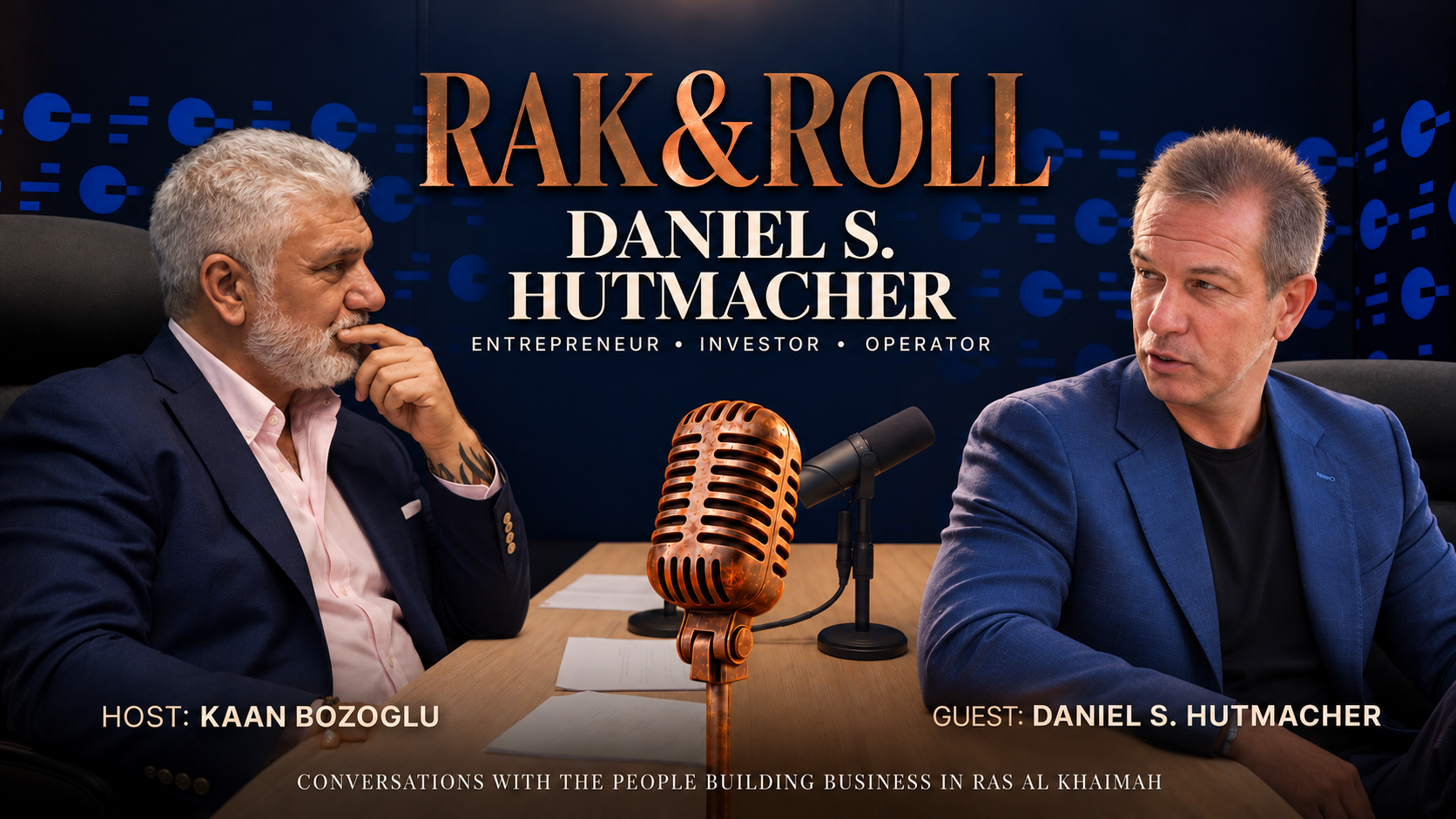
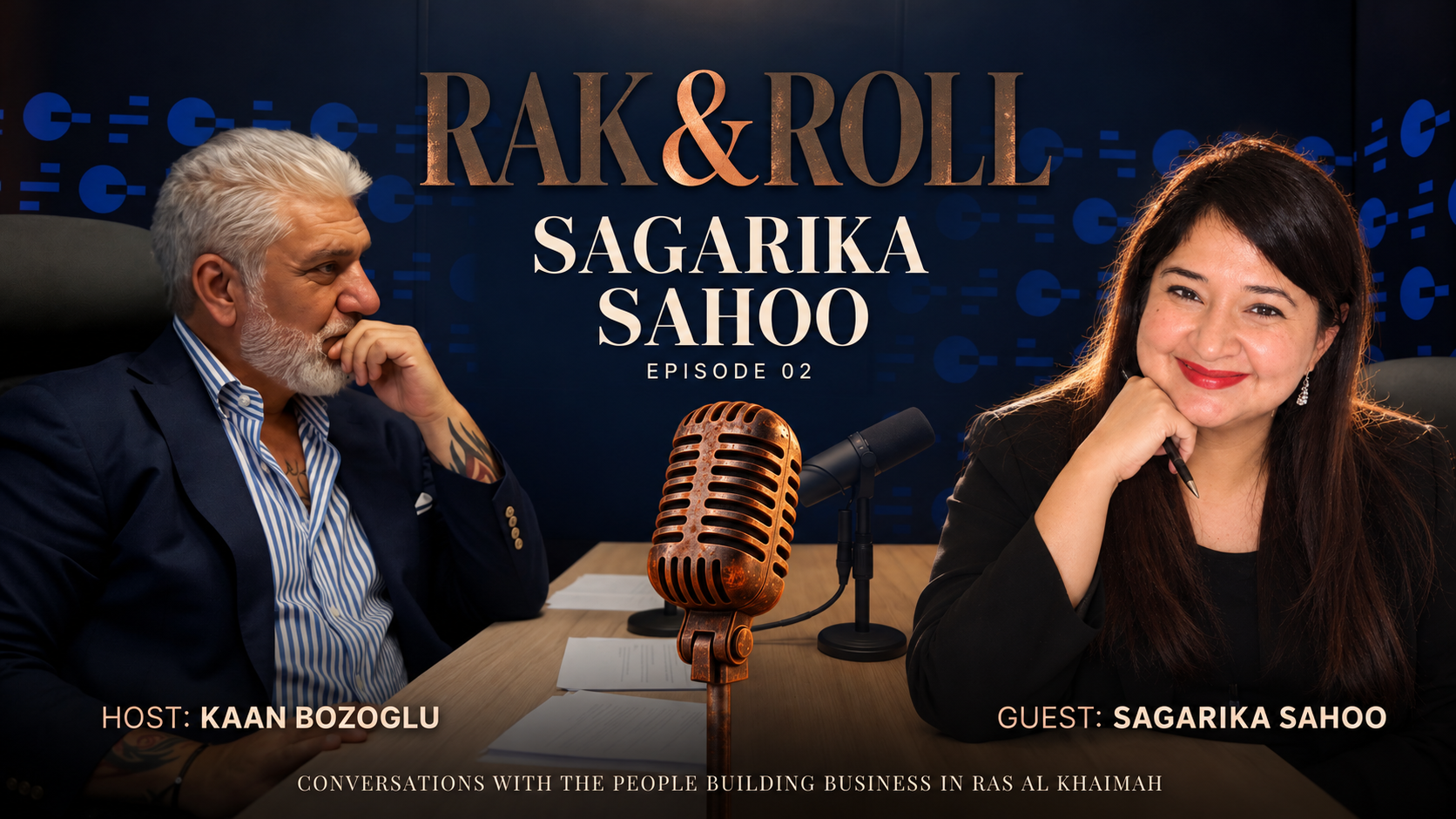
Episode 5 · November 15, 2026
From Volume Maker to Lifestyle Brand: Inside RAK Ceramics with Leonardo de Muro
Leonardo de Muro joins Kaan Bozoglu to discuss RAK Ceramics’ shift from volume manufacturing to a lifestyle brand, adapting to the UAE, and leading a multicultural marketing team. The conversation also explores design partnerships, AI, ambition, and the family sacrifices behind an international career.

The full conversation
Listen on Spotify.
Hear the complete conversation, then explore the episode notes and transcript below.
Watch the episode

Episode overview
The conversation
After a career in Italy’s ceramics industry, Leonardo de Muro moved to Ras Al Khaimah with a clear purpose: help reposition RAK Ceramics from a volume manufacturer into a lifestyle solution provider. He explains how listening to colleagues, following changing customer needs, and working across production, sales, and marketing supported that transformation.
Leonardo and host Kaan Bozoglu discuss bathroom design and wellness, large-format tiles, and the role of Elie Saab and Cavalli in the company’s multi-brand strategy. They also examine practical uses of AI in marketing while keeping human creativity at the centre.
The full audio conversation turns to life in Ras Al Khaimah, Italian identity, ambition, and the cost of living apart from family. Leonardo closes with advice on determination and making time for the people who matter.
Key takeaways
What stands out
- Brand repositioning requires cooperation across marketing, production, sales, and management.
- Listening to a multicultural team helps leaders adapt to a new market.
- Customer needs and design trends shape product development, from wellness spaces to large-format tiles.
- Fashion partnerships can support a broader brand strategy when product design and positioning align.
- AI can support marketing execution and planning while people provide the creative direction.
- An international career can involve family sacrifices that deserve deliberate attention.
In this episode
What we discussed
Leonardo’s upbringing and career in Italy’s ceramics industry
Moving to Ras Al Khaimah with a specific professional purpose
Repositioning RAK Ceramics as a lifestyle solution provider
Listening, leadership, and working with different nationalities
Bathroom wellness, technology, and changing design preferences
AI in graphic design, social media, catalogues, and planning
Elie Saab, Cavalli, and the multi-brand strategy
UAE manufacturing and Ras Al Khaimah’s development
Ambition, family, and advice to younger professionals
Marketing
Marketing discussion
Leonardo describes the move from volume manufacturing to lifestyle positioning as a company-wide effort. He discusses adapting to different markets, listening to his team, responding to consumer needs, and using Elie Saab and Cavalli partnerships to support the brand’s positioning. AI supports areas including graphic design, social media, catalogues, and planning, while creative direction remains human-led.
Local context
Ras Al Khaimah and the UAE
The conversation was recorded at Innovation City in Ras Al Khaimah. Leonardo discusses the emirate’s pace of life, beaches, mountains, and social connections, alongside the challenges of leading a multicultural team in the UAE. RAK Ceramics provides a local manufacturing perspective on serving international markets and responding to development within Ras Al Khaimah.
Key moments
Chapters
- Introduction: Leonardo de Muro and RAK Ceramics
- 1:14 Growing up in Italy’s ceramics industry
- 2:33 Life in Italy and Ras Al Khaimah
- 5:04 Moving to the UAE to reposition RAK Ceramics
- 7:03 Adapting to a new market and listening to the team
- 10:05 Changing customer needs, wellness and design trends
- 16:36 Transforming a manufacturer into a lifestyle brand
- 20:21 AI in marketing and human creativity
- 23:29 Showrooms, customer feedback and UAE manufacturing
- 26:11 Cavalli, Elie Saab and the multi-brand strategy
- 29:18 Continue the full conversation on Spotify
Topics
Subjects in this conversation
- Moving to the UAE
Transcript
Full conversation transcript
Cleaned transcript · EN
YouTube excerpt transcript. Video duration: 29:37. The full 43:42 conversation is available on Spotify.
[00:00:06] Kaan: All right guys today we are with Leonardo De Muro, and he is from, as you can see, from RAK Ceramics, and being here basically globalizing the company so we're gonna have a little bit of chat. All right, Leonardo, right?
[00:00:24] Leonardo: Yeah.
[00:00:24] Kaan: You're originally from Italy.
[00:00:26] Leonardo: Yes.
[00:00:26] Kaan: We were just talking about it. You came directly from Italy?
[00:00:31] Leonardo: Yes.
[00:00:31] Kaan: Second country?
[00:00:32] Leonardo: Yes, yes, right.
[00:00:33] Kaan: Before coming here, how was life in
[00:00:36] Leonardo: But listen, I came here with the purpose, no, and the choice of working for RAK Ceramics naturally came because all my life, all my, how can I say, my profession was in the ceramic industry. So since I was 18, I was in the ceramic industry. Today I'm 61. So you can imagine how many years I spent in the... I don't know any other industry.
[00:01:07] Kaan: Was that your dream type of thing? Because it sounds a little weird, no? No. As a child, people dream to be astronauts or something like that.
[00:01:14] Leonardo: Not exactly. All my life, I wanted to travel. I cannot deny that. All my life, I wanted to explore the world. And you know, in the place where I grew up, because I was born in Milano, but I moved to Carpi, which is a small village close to Modena. There are two industries, the one producing fabrics, and we were very famous for that until the beginning of the 80s, or the tiles manufactured. Actually, Sassuolo, which is also the other small city close to Modena, which is 50 kilometers from the place where I live, is very well known all over the world for the ceramic industry. As Italian, we are saying that the ceramic industry was born in Sassuolo. So there was only two, oh, I would have the possibility of going into the fabrics industry or in the tiles. I decided to go into the tiles.
[00:02:16] Kaan: That's how it was, like an organic evolution.
[00:02:19] Leonardo: Absolutely. Absolutely.
[00:02:20] Kaan: It wasn't a choice thing. "No, I'm going to do this."
[00:02:23] Leonardo: No, no, no, no. Absolutely. Absolutely.
[00:02:25] Kaan: You grew up with it. How was life like in Italy when you were living in Italy, like in terms of social life, work life?
[00:02:33] Leonardo: You know, our life is it's an excellent life. We enjoy our life. We as Italian, we like to stay all together. We like to spend our free time with friends. It's different, of course. We are a very warm country. I mean, actually, I know. It's pretty different from what I found here. I love this country, by the way. This is very important. Everybody knows about that. But here is purely business.
[00:03:11] Kaan: In Ras Al Khaimah? If you would say Dubai, I would say...
[00:03:14] Leonardo: No, I'm talking about the country in general. Then we come to Ras Al Khaimah. And the way you are thinking here is more always on what I should do tomorrow, what I should do tomorrow. I'm working 24 hours a day, by the way, here. In Italy I was enjoying more my life. Now Ras Al Khaimah is a different area of the whole country, probably how it is configured today, it's a place where you can enjoy your life, because it's not so frenetic like Dubai, Abu Dhabi, you know, here you have the beaches, you have the mountains, and I would say that the people I found here is even more friendly, it's easier to have a friend here rather than in Dubai, because all the friends I have in Dubai and I spend a lot of time also in Dubai are mainly for business. Whenever I meet them I talk about business, I talk about work. When I'm in Ras Al Khaimah, I'm talking about the weather, the sea, the families, you know it's a different style.
[00:04:28] Kaan: Dubai to me it feels like a giant convention center. Every time you go, the conversation automatically switches to business, right? Here is more relaxed, more friendly. And actually, I could even draw a parallel with Italy. And here, the social life is somewhat integrated into the business life here. Right. In Italy, like, I've been to multiple business meetings. We never met in a boardroom, never in Italy, always in a restaurant.
[00:04:58] Leonardo: Oh, yeah, yeah, five hours, eating at the same time, drinking at the same time.
[00:05:04] Kaan: Yeah, yeah, yeah. What was the reason you came here? Was that somebody influence or?
[00:05:10] Leonardo: No, listen, I was called. At the time, I was working for another very important ceramic industry in Italy. And they came up with a proposal, which I took it because I saw in it what I couldn't do in the past in the company I've been working for. Starting something from scratch, rebranding RAK Ceramics. RAK Ceramics has always been a volume maker in terms of tiles and sanitaryware. And when they call me, they call me with a purpose. We need to bring this company from a volume maker company into a lifestyle solution provider, which I love, you know. And you know, as a head of marketing, this was my dream, honestly, and I came here and I found not only a fantastic company to work with, but also a family, you know. And today I'm still here, you know, after eight years with the same spirit when I came, you know, when I was 53.
[00:06:26] Kaan: There is something interesting about your story. Everybody that I talk to, there is an element of adventure in it. In yours, there is no element of adventure. You already knew where you were going when you came here, right?
[00:06:39] Leonardo: Absolutely. Absolutely. Absolutely.
[00:06:40] Kaan: So it was more purposeful. There was an intent already.
[00:06:43] Leonardo: That's probably also because of the age, you know, when I came here, I was 53. So I was already at the mature stage today. I'm 61. So it was with a different perspective. So it was clear in my mind, I'm going there to do this. And I want to do that. Okay, so this is this.
[00:07:03] Kaan: I'm in marketing, so there are obviously some questions for you. I see it with my clients, I see it with my company too. Every time we go into new market, the existing marketing understanding doesn't translate because the culture is different. Yes.
[00:07:22] Leonardo: Yes.
[00:07:23] Kaan: So how did you somehow find a way to adapt the cultural elements of the marketing elements of the product to bring it to your understanding or did you adapt yourself to the
[00:07:36] Leonardo: It's a combination of things. For sure, when you go to another country, the UAE is not Italy, but it would have been the same if I would have chosen Singapore or China or Australia. You have to adapt yourself. Then when you have a wonderful team as I have in these moments, I had the possibility of discussing with them many things and we started to compromise each other till we find the right way to work together.
[00:08:10] Kaan: So you went through some sort of experimentation period that you measured the responses?
[00:08:16] Leonardo: Not really, because in marketing you have to be always open. You cannot think, OK, I'm trying to experiment something. Let's see how it's going. And then I found the method of working. It's still today. you know.
[00:08:32] Kaan: Yeah, there's always fine-tuning.
[00:08:35] Leonardo: Yes. Yes. Yes. It's a combination. The good thing I have, and I'm saying that because I'm quite proud of this, I'm listening a lot. So I like to listen. I don't like to impose myself. So whatever is coming from my team, I'm listening. Probably I try to find out what are the differences between what I have in mind and what they are saying, but in the majority of the case, no, I'm trying to follow what they are saying, you know. And this is important because what I'm seeing also in this country generally, but this is because what I found out, people in the other departments are trying to follow what the boss is saying, which is something I hate. I like people who come to my office and tell me, Leo, you are wrong. We should do it this way. If someone comes to my office and tells me it's great, because at the end of the day, I understand that I don't have yes men working with me, but people with the proposal, people with the creativity, people with an idea, which is the base of marketing today.
[00:09:52] Kaan: You know, yeah, so what you're saying is not you're not expecting somebody to challenge your ideas only in the name of challenging. Whenever there's a challenge. There should be an alternative proposal some sort of a vision Presented to you. Yes. Yes. How about the cultural elements before? Besides the taste like the practical elements especially as you're in a ceramics business, you do a lot of things I saw what you guys do. I'll give you some real example, real life example. Like in here, Al Hamra Village was one of the older expat-related villages, right? And still majority of the houses there use bathtubs. Yes. Here, I live in Malibu. I live here in Mina. Almost every single house in Malibu has showers. That's a cultural shift from bathtub to shower. So what was your position? How did you position yourself? I assume that you guided the company towards something that's coming, not what has been.
[00:11:05] Leonardo: Yeah, but this was not me actually. This is the natural evolution of, and the trends of the needs of the people that we are following, okay? This is not only here, it was the same in Italy, it was the same in UK, you know? And for sure, there are a lot of studies behind that, there are a lot of initiative you take also to follow, but I wouldn't say that this is something that came directly from RAK Ceramics. RAK Ceramics adopted what was a natural evolution of the request of the market. What you are doing today, you are following what the market is requiring you to do. Now, you can be a trendsetter for sure. You can be the first one to propose something, fine, but the majority of the case. No, it's a combination of factors which are bringing you and the people know, yeah, make a choice.
[00:12:11] Kaan: Again, coming back to bathrooms. That's what I'm going to give you an example of. Like in North America, all the new houses built, not with shower cabinets, yes, with shower rooms.
[00:12:22] Leonardo: Yes. Yes.
[00:12:23] Kaan: Right. It's like this size, probably the studio size. And there's water coming all over the place, whatever it is. I haven't seen that here yet. I assume in Dubai they might have some.
[00:12:34] Leonardo: Yes, they are starting. This is again the evolution and the trend that is changing today. We try also to avoid the word bathroom today. We are trying to adopt the word wellness from the spa and create these sorts of rooms with different concepts, different ideas. Today the bathroom is a room, no?
[00:12:58] Kaan: Yeah, especially the way I say.
[00:13:00] Leonardo: Absolutely, it's a luxury place. It's one of the places. Before, you didn't even want to show the bathroom to your guest. Today, if you do the bathroom in a certain way, it's one of the rooms you want to show first. You want to show which kind of products you put inside the latest technology consider that in a bathroom today, you're using technology. Think 20, 30 years ago, that was not... even seven years ago, it was not even in the mindset of who was making a bathroom to use the technology, to apply the technology to the bathroom, you know?
[00:13:47] Kaan: Who do you think is ahead in this game? I would say Japan, because I was in Japan 10 years ago the bathrooms were 100%.
[00:13:55] Leonardo: But today, China. China is one step ahead, I believe, of Japan. Listen I was in China a couple of weeks ago and I was amazed. I was used to travel a lot to China till 15 years ago, when I was in Italy one of the countries that I always looked at as an example was China. Then it was quite a long time I was not going to China. I was there, I was amazed. Electric car, electric toilets.
[00:14:31] Kaan: But the heating, with massaging and everything, right?
[00:14:34] Leonardo: You know, incredible, incredible, incredible. I cannot explain how surprised I was. I knew but when you see with your eyes, it's something different.
[00:14:44] Kaan: Did you ever consider, again, I'm coming back to ceramic because it interests me. I travel a lot, and I see places like there's this typical South American style. Actually, as far the weather goes, it would be very like, you know, the Mexican tiles, they're like roughly 12 inch by 12 inch. The burgundy type of color or the camel color tiles. I would expect to see them here. I don't, but I see completely different material here. I assume this is cultural, that's what I meant as cultural.
[00:15:20] Leonardo: Absolutely, this is cultural. Yes, yes, yes, yes. This doesn't exclude, we have among our collections something which looks alike, because we have, but what RAK Ceramics is trying to do in this moment is trying to cover the majority of the needs are coming from the different countries. When you have a specific product like they have in South America that was also what they had in Spain also for years because you know that Spain brought this to South America, you know, is changing now, you know. And this is part of how to use the product today. Today the product, the ceramic product, the tiles themselves are part of something that we call fashion in between in the brackets, why fashion? Because we are trying to follow trends. We are trying to follow colors. We are trying to go on large format, big formats. Today, take a company like RAK Ceramics. We develop products from a five by five centimeter tile up to 160 by 320, you know? It is a huge slab that today is replacing what was the use of marble before, no?
[00:16:36] Kaan: Besides work, what surprised you when you came to UAE? Everything was what you were expecting, or there were some surprising elements for you?
[00:16:45] Leonardo: No, to be honest, no. To be honest, it was exactly what I expected. A country... I have to be honest with you. I came before on vacation, but this happened seven years ago, No, seven years ago, seven years before I decided to move here. And I saw the frenetic way of trying to speed up a process of modernization in this country. It was there, they were building a lot. So when I came here, there was nothing I did not expect. Actually I came here and I found what it was in my mind.
[00:17:29] Kaan: So you came here, you adapted fast because you were expecting, you knew what was going to come.
[00:17:36] Leonardo: Then I'm Italian, you know, all the Italians adapt fast, you know.
[00:17:41] Kaan: How did you manage to take the company to a global market? Like what were the challenges to take it to a global market, to become a global brand?
[00:17:53] Leonardo: Well, RAK Ceramics was already known all over the world. And the difficulties I work on is to transform, as I said at the beginning, into a lifestyle company, to transform a volume maker into a lifestyle company. We work hard, but I was not, of course, the only one. I have to thank the production team that follow us. I have to thank the salespeople that are promoting the products that we are developing every day with consistency. I have to thank all the people that in RAK Ceramics follow this transformation. And then, of course, I have to thank also the management that supported us as a marketing, what we are doing, what we are doing and what we are doing today.
[00:18:43] Kaan: That was my second question, but it kind of has answered already based on your history, because they demanded you to come here so there was a like preset relationship built already since there was a demand particularly.
[00:18:59] Leonardo: No I believe because let's be realistic I don't want to look like I'm too close to my country which is true by the way but for me no the tile industry is Italian. Spanish would say No, we are the one. There is always this dispute between Italian and Spanish, you know,
[00:19:21] Kaan: Because of Mexico?
[00:19:23] Leonardo: Okay, tiles are produced all over the world but the trend But the fact that for me like Many other people it is an Italian industry. This is probably why no they choose the I Don't want to say me probably me by coincidence or I don't know But they wanted to have probably an Italian to drive the marketing team.
[00:19:52] Kaan: Plus you grew up with it, so you were an excellent choice. You know what I mean. Then somebody's coming from bottom up. They know more than what somebody did.
[00:20:03] Leonardo: Yeah, that's probably. But I don't like to talk about me in this, you know, why they choose me rather than I prefer to be recognized as someone that every day is going to work in an humble way and try to do his business and achieve the results that the company wants.
[00:20:21] Kaan: You're being humble. There is a vision part of it. You know what I mean? Especially in marketing because I would say two-thirds of marketing is creativity. It's imagination. Like when I give classes I tell the kids all the same thing. I teach AI. AI doesn't mean anything. AI is just a tool. The value is how much you can dream, how much you can imagine. AI lets you explore all the possibilities. Did you guys integrate AI into your process?
[00:20:52] Leonardo: Yes. We are integrating in graphic design, in social media, catalogs. We are integrating in a good portion of our marketing activities.
[00:21:08] Kaan: UAE is taking large, large, large steps to integrate AI.
[00:21:14] Leonardo: Absolutely. They develop also an AI engine. Yes.
[00:21:18] Kaan: Yes. This is this building. Yeah. We are the AI capital of UAE. Yeah. Or we will be soon. I don't want to piss off people in Dubai, but we will be probably the capital of the AI in UAE.
[00:21:31] Leonardo: But again, I always see AI not as an alternative to the work of the people they complement the work of the people.
[00:21:39] Kaan: Do you know the term rabbit hole? No. Okay it's an American term basically what it is is you know rabbit holes are small tiny holes so from outside if you look it's just a tiny hole when you try to go in it would be endless because there would be labyrinths inside right. So what AI does is allow you to explore every single rabbit hole so it unchains your imagination, but the driving force is still the imagination. AI is the tool allows you to explore it. So that's why I said, did you guys integrate any creativity or you personally integrate any creativity? AI in creativity?
[00:22:22] Leonardo: Not yet. And I want to stay a little bit out for the moment because the creativity for me should stay in the human being so what I think what my team is thinking every day should stay no no should stay there no
[00:22:37] Kaan: What I meant was like the initial idea initial the inspiration is still coming from you absolutely allow you to explore the angles possibilities
[00:22:50] Leonardo: Yes yes we mainly use in this case to check or to try to understand what we are putting in plan or what we are thinking, no, at the end of the day, reach the scope. So in this way, AI is helping me. AI is, he can say or he can give me a bit of direction on this, you know, or how to achieve it, no? But the idea itself is us.
[00:23:21] Kaan: But AI would help you with the methodology.
[00:23:23] Leonardo: This is true.
[00:23:26] Kaan: True. When, whatever you guys put out as a catalogue, I don't assume that you sell B2C, right?
[00:23:37] Leonardo: We sell B2C, we sell B2B. We sell B2C, too? Absolutely. We have 11 showrooms in the country. Okay. The biggest one are the one that we have here in Ras Al Khaimah, our headquarters, which is 1,400 square meters of showrooms. And the second one, the second largest one, which is 1,200 square meters, is in Dubai. And then we have showrooms almost everywhere, every states, yeah, absolutely.
[00:24:05] Kaan: That would allow you to get the consumer feedback, right?
[00:24:09] Leonardo: Absolutely, yes. We have an excellent rating, by the way.
[00:24:13] Kaan: I'm more interesting that rating is great. That means the clients are satisfied, but I'm more interested in again the original ideas like because sometimes consumers they have interesting when I'm saying rating.
[00:24:27] Leonardo: I'm not saying in terms of Google rating or the one that you can find on the web. I'm saying positive feedback from clients. Absolutely. We are recognized from a client as a leading manufacturer, capable to compete at any level. So, and this I'm proud of this.
[00:24:50] Kaan: You think you are able to compete with Italians?
[00:24:52] Leonardo: 100%. Today, we are capable to give you a product which looks like an Italian product. The only thing when you turn back the product, you find made in UAE instead of made in Italy.
[00:25:06] Kaan: You know, this is for somebody who's listening from another country. This is extremely interesting because I came here with preset notions about what UAE is. I thought all UAE is like a spaceship because if you go to Dubai, it is like a spaceship. It's extremely, extremely modern, right? So I thought that would look like a spaceship. The second UAE would be generating their revenue from tourism and oil. But it's not true. we have so many manufacturers. We have a manufacturing company here, one of our clients, manufacture solar panels and able to compete with China on top of it. This is like unexpected, it was unexpected for me when I found that. So you are another example, you are actually manufacturing.
[00:26:03] Leonardo: And we are proud of that, of course.
[00:26:05] Kaan: Yeah, of course, it's something to be proud of. No, that's great. That's great. Let's come to a little bit more exciting stuff. At RAK Ceramics, you guys worked also with major, major names like with Cavalli.
[00:26:23] Leonardo: Yeah, this was a choice of the company to enter into the multi-brand activities. And among the multi-brand, we categorized an area that we call the House of Fashion, and Cavalli and Elie Saab are the first two fashion brands, part of this multi-brand strategy, which didn't come by coincidence. We were looking for that. And we were looking to have two important brands capable to express also what we had in mind. Elie Saab is part of this world. Elie Saab is a fashion house from Lebanon, very well known in the region. So we were looking for it when we took it, and it gave us a great result. Then we felt the need also to have an Italian, no? And among the Italians, something that was already integrated in this part of the world because, you know, Cavalli was part of DAMAC before, you know, the big developer of Dubai, and we were looking for it and we took it. Now Cavalli has been launched two weeks ago during the design week in Dubai. Elie Saab has been with us for the last five years. We can see that the success we are collecting from this strategy is huge, is amazing, It's amazing. And this contributes to elevate the brand of RAK Ceramics, more than what we have. So, strategic decision, yeah.
[00:28:13] Kaan: Yeah. But I'll ask something else. When you manufacture, you have products that they are similar to each other, right? Yeah. What do you think the consumer, the end user, the criteria for them to choose one over other? Do you guys want to balance it? you want to separate it like basically distant them from each other.
[00:28:36] Leonardo: But products for sure are different. When we're talking about the fashion brands, you're talking about different products with different look like and then they are branded products. So when you buy a Cavalli tile or you buy an Elie Saab tile you buy a brand. It's like a T-shirt I'm wearing a T-shirt of Abercrombie, which costs 200 dirhams. If I wear a T-shirt of Dolce & Gabbana, probably is the same cotton, but it's a Dolce & Gabbana branded, you know, probably is the same color. Yeah. Even if I have to say that the products that today entice your buying.
[00:29:18] Voiceover: You can listen to the rest of the conversation on RAK & ROLL's Spotify channel. Are you ready to share your story on RAK & ROLL? Guest invitations are now officially open. We want founders, business owners and operators. Nominate
Keep watching