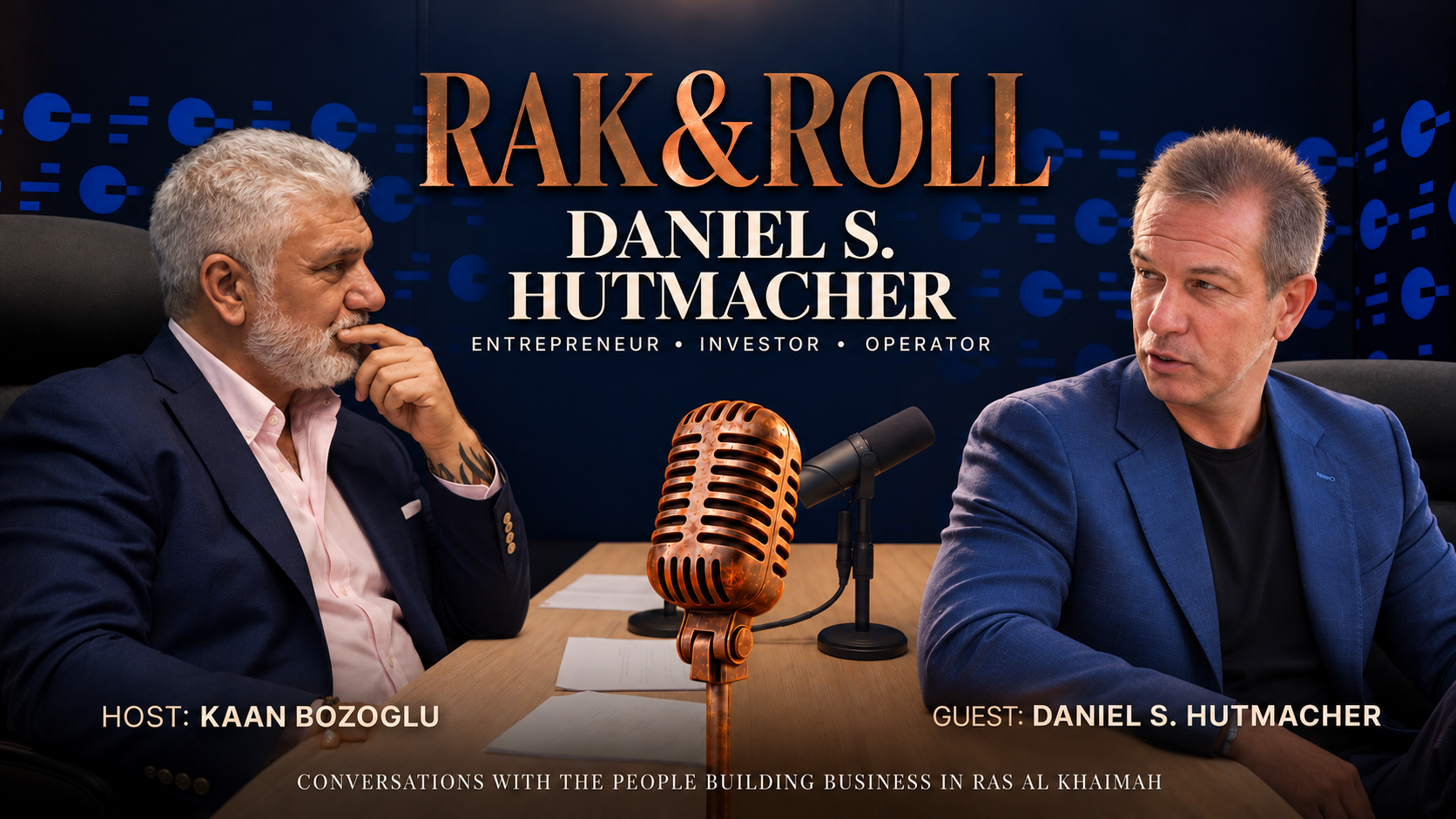
Episode 4 · November 8, 2026
Daniel S. Hutmacher: From Swiss Chocolate to Electric Vehicles in RAK
From opening hotels in Papua to making Swiss chocolate in Ras Al Khaimah, Daniel S. Hutmacher shares the lessons he brings to his electric vehicle venture.

The full conversation
Listen on Spotify.
Hear the complete conversation, then explore the episode notes and transcript below.
Watch the episode
Episode overview
The conversation
Daniel S. Hutmacher trained as a confectioner and chef in Switzerland before studying hotel management in Lausanne. His next steps included cooking at a nuclear power plant, opening a five-star hotel in the jungle of Papua and learning enough golf from hotel guests to take on a project he had never played before.
In this conversation with Kaan Bozoglu at Innovation City, Daniel traces the route from international hospitality to entrepreneurship in Ras Al Khaimah. He describes adapting to different cultures, moving to the UAE with his family and leaving a regional hospitality role to start a chocolate business.
Making the product was one part of the work. Selling it meant getting in front of chefs, following up, travelling between hotels and delivering a consistent message. Daniel explains how his hospitality relationships helped him reach buyers, and why Swiss chocolate made in Ras Al Khaimah challenged customers' expectations about where a premium product should come from.
The full Spotify conversation continues beyond the chocolate story. Daniel explains why he closed the business in 2019, recognised gaps in his own marketing and finance knowledge, and returned to studying. He then discusses SAQAR, his electric vehicle venture, including plans to build AI into operations from the beginning and document the work behind the business as it develops.
We also talk about the daily experience of living in Ras Al Khaimah, the value of local relationships and the difference between chasing recognition and building a business that works for its team. Daniel's advice to his younger self includes keeping financial reserves, protecting his health and accepting that he cannot be the best at everything.
The YouTube edition covers Daniel's early career, his move into entrepreneurship and his chocolate business. Listen on Spotify for the full conversation, including why he closed the chocolate company, his electric vehicle venture, plans for AI and building an audience, and how his definition of success has changed.
The chapter links below follow the YouTube edition. The full transcript follows the Spotify conversation and uses a separate timeline.
Key takeaways
What stands out
- Relationships opened the first doors. Daniel used his hospitality contacts to reach chefs, demonstrate the product and create demand within hotels.
- Consistent follow-up was a large part of the sales work. He describes returning to customers repeatedly, with the same message and a product they could taste.
- A product's identity can be difficult to explain. Customers familiar with Swiss chocolate did not necessarily accept the idea of producing it in Ras Al Khaimah.
- Production standards still need a viable market. In the full conversation, Daniel reflects on how the chocolate company lost market share and eventually closed.
- Recognising a knowledge gap creates a practical next step. Daniel returned to studying finance, marketing and business development after identifying his limitations.
- His next venture draws on those earlier experiences. Daniel describes plans for AI-supported operations, documenting the development process and building a community around the vehicles.
- Success became less about personal recognition. He now talks about a functioning company, a team doing good work, health and knowing when he has enough.
In this episode
What we discussed
Training as a confectioner, chef and hotel professional in Switzerland.
Opening hotels in Papua and Java, and adapting to new cultures.
Moving to the UAE and leaving employment for entrepreneurship.
Setting up chocolate production in Ras Al Khaimah.
Selling to hotel chefs and managing expectations around Swiss chocolate.
Closing a business and returning to study.
Developing SAQAR and planning AI-supported operations.
Documenting the work behind a business before the finished product is ready.
Community, family life and the appeal of Ras Al Khaimah.
Financial reserves, health, mentorship and a changing definition of success.
Marketing
Marketing discussion
Daniel's chocolate sales began with relationships he had built in hospitality. Rather than starting every conversation at procurement, he could speak directly with chefs, let them taste the product and work through the purchasing process once there was interest. His account centres on personal contact, repeat visits and a consistent message.
The harder positioning question was how to explain Swiss chocolate manufactured in Ras Al Khaimah. Daniel describes customers who associated authenticity with buying in Switzerland. The discussion explores the gap between production quality and the identity a buyer attaches to a product.
In the full Spotify conversation, that experience informs his plans for SAQAR. He wants to document the development process, from building the factory to assembling the team, and give people a reason to follow the business before its vehicles reach the market.
Local context
Ras Al Khaimah and the UAE
Daniel describes choosing Ras Al Khaimah for his chocolate business because of the setup process, available premises and the practical needs of family life. His story includes converting a warehouse into a controlled production environment and travelling to hotel customers elsewhere in the UAE.
The personal connection matters too. He talks about knowing his neighbours, walking in his community and meeting people from different backgrounds. Later in the full conversation, he reflects on how doing business in the emirate has changed, while explaining why its pace and relationships still appeal to him.
Key moments
Chapters
- Intro
- 0:12 From Swiss confectioner to hotel school
- 1:38 A chef in a nuclear power plant
- 2:19 Opening a five-star hotel in the jungle of Papua
- 4:29 Learning golf from the hotel guests
- 5:42 The 1998 crisis and the road to the UAE
- 7:30 Hidden privileges and adapting to new cultures
- 8:48 Fluent in Bahasa Indonesia in six months
- 10:11 Why he'd rather live in Ras Al Khaimah
- 11:39 "Hi, brother": the UAE welcome
- 13:25 From employee to entrepreneur
- 14:42 Hired for strategy, stuck firefighting
- 15:34 No parachute: jumping off the cliff
- 17:23 Setting up in Ras Al Khaimah in 2009
- 19:09 Selling chocolate to five-star hotels
- 23:13 Swiss chocolate, made in Ras Al Khaimah
- 25:30 Share your story on RAK & ROLL
Topics
Subjects in this conversation
- Moving to the UAE
- Starting a business in the UAE
Transcript
Full conversation transcript
Cleaned transcript · EN
Full Spotify conversation transcript
Timestamps follow the full Spotify conversation, not the shorter YouTube edition.
RAK & ROLL | Episode 4 | Daniel S. Hutmacher
Host: KAAN Bozoglu | Guest: Daniel S. Hutmacher, CEO, SAQAR EV Mobility Platform
Recorded at Innovation City, Ras Al Khaimah
Running time: 66:18 (timestamps match the cleaned audio file)
Speakers: KAAN = KAAN Bozoglu (host), DANIEL = Daniel S. Hutmacher (guest)
Machine transcript with speaker labels, proofread for names and places. Short interjections
("yes", "correct") sometimes sit inside the other speaker's line.
------------------------------------------------------------------------
[00:00] KAAN: Okay, let's start with your story now. Before the business, before coming to business, where did you live before here?
[00:08] DANIEL: Before here, what is here? I lived in Switzerland
[00:14] KAAN: So you were like you were born there you grew up there and you stayed there
[00:18] DANIEL: Okay we start at the beginning I was born there in a German speaking part and I was raised in a French speaking part okay I have two mother tongues and then I did my apprenticeships my curriculum going through, I'm a confectioner and that was in a French speaking part, also German speaking part, I moved, then I started to work in that field in a French speaking part. Then I became a chef apprenticeship again, because I My god, you're a chef? Yeah, yeah.
[00:54] KAAN: Oh, that's so exciting, I
[00:57] DANIEL: Wanted to
[00:58] KAAN: Chef life is very exciting.
[00:59] DANIEL: Oh yes it is. So I wanted to access to the Hotel School of Lausanne. Yeah. The number one in the world. So to do that, I had to become a chef, or a waiter, or another hospitality job. So I choose to become a chef. I invested another two years in that. And then I worked two years as a chef prior to the hotel school. And then went to the hotel school, three years. And straight after that, I was a chef in a nuclear power plant.
[01:33] KAAN: I needed money. It's even more interesting than working in a hotel.
[01:37] DANIEL: You get out of the studies, you're broke. Yeah. Usual, right? I didn't have a burden, but I was broke. So there was a job advertised nuclear power plant, too much job, highly paid. It was the reviewing of the power plant, shutting down, x -raying everything and so on and so forth. So then he did somebody. Is that okay? I'll take the money. None of my colleagues at the hotel school thought that job was at their level, it was way beneath them. I needed the money. Okay, fine. And then I was already married by then and my wife is also from hospitality and then we wanted to go into Asia. We wanted to go and work in Asia because that was the normal field to go and experience Asia. So we finally found a job through the hotel school alumni mafia, we're 25 ,000 active in the world. And we found a job in as an opening of a hotel, Sheraton, in a jungle of New Guinea, the Indonesian part. It's called now Papua. It was by then it was Irian Jaya, now it's Papua. And we opened a hotel, Sheraton Inn. you understand the level of it is. Yeah. We were five star. Sheraton Inn.
[02:56] KAAN: Yeah, normally Inns are not five star, no?
[02:58] DANIEL: No, exactly. We had an elevator for a Swiss elevator for one floor. We had Swiss hand painted set plates for dinner, $90 the piece in 1993, and so on and so forth. So it was crazy. It was very interesting. We definitely had to pull up our socks coming from Switzerland going to the jungle. It was new food, new culture, new language, new set, new environment, jungle humidity, 90 percent your matches would froth because it was so humid. You had to remove the doors of your cupboard with your clothing and put a light bulb switched on all the time to create heat and to create a movement otherwise your clothes would get moldy just like this so completely different and it was fantastic we spent two and a half years over there opening the hotel and then running the hotel mean as as managers and I also had the opportunity to be the do you prepare the whole project? I never played on the golf. I was transferred three weeks before. I never played golf before, so to attain knowledge of golf, I went to see my clients in the bar in the hotel and said guys I'm in charge of a project from the hotel side. I need to understand. Teach me. Exactly. And I said come tomorrow morning. It was a Saturday the evening, Sunday morning, go there they give me a coin and they give me a stick about that size. A foldable golf stick, an iron and you could play everything with it. It's short game of course. So we went into the jungle where they had a short nine riverbed. The playing area was sand mixed with jizzle so it would be sticky with the rains wouldn't run off too much fairway was fairway So if you miss it, you miss it. You don't go after it. It's jungle and Then the the hole around the the flag you had to go on your knees dig it out Put the flag back and crawl back and clean the place So that's how I understood golf and played golf and came to golf. So then I got transferred to the central of of Java and opened another hotel over there. I mean food and beverage there. And then the crisis of 98. George Soros FX toppling all the Asian currencies kicked us back to Switzerland and went to work in a five -star hotel in Lucerne, then to Gstaad, four -star hotel, strong F &B and then went to Lausanne in a large Mövenpick Hotel as number two. Yeah. Then I got the opportunity in 2005 to come here through Mövenpick as regional food and beverage.
[06:13] KAAN: Oh, okay. So you came, it wasn't an adventure for you. Like, you didn't say let's pack up and go to UAE?
[06:20] DANIEL: No, no, no, that was planned. That was planned to come here. Three kids, family come here and have a look and start it up. Regional level. So if you want, it was a little bit crazy decision. Okay, the CEO came to tap on my shoulder and said, I would like you to go. Okay, I wanted to go anyway. And then came here. So in Los Angeles, I had three restaurants plus catering plus whatever you want. And here I had 150 restaurants throughout Jordan, Egypt, Saudi, Oman, Qatar, Kuwait, et cetera, et cetera. So you have a 10 fold. Yeah. Plus you travel constantly. Yeah. So I was setting up that food and beverage regional. Technically my job was GCC. My job at the end was everything outside Europe. Phuket was on the list. Of course. Egypt was on the list. Mauritius was on the list.
[07:17] KAAN: It's so good. It's so good. I'll ask you something like this is what my experience was. Okay. Number one, when you go to Asia, if you're coming from Western country, you have certain privileges. They are in hidden privileges. Correct. They are not written on the paper, but you do have privilege.
[07:34] DANIEL: I call that the white passport. White nose passport.
[07:37] KAAN: I wouldn't even consider myself white, because like I'm half Greek, half Turkish, grew up in Canada, lived in United States, whatever it is. I don't even know what I am. But the moment you start living in Asia, the cops go like this to you because they don't know who you are. Yeah. So you have a huge amount of privileges. So, but now I assume that you experience the same things in Asia, right? Definitely. You're living there. Yes. But you also got trained in terms of changing culture and changing social structure. Once you do it, doing it the second time is much easier. The reason I'm saying that is if you came from there back to Switzerland. Coming here, now you know the game, you know how to adapt to a different culture, how to adapt to a different language. So the second time is not that difficult, right?
[08:32] DANIEL: No, it's much easier and if I may step back into Asia, location number one and then location number two, location number one is a pretty much a shock. You come from beautiful Switzerland, you go into the jungle, it's pretty much a shock. It's tough. And from day one to day two, you need to know the language. So in six months, we were fluent in Bahasa Indonesia, head two. And then the second location, you still have these advantage, but you don't play them too much. You behave normally with the people and you have built up that knowledge, respect, culture, language, religion and so on and so forth. So yes, already built that up over there. then went back to Switzerland was found okay to transition because it was not too long in Asia we wanted to stay and then came down here it was a new cultural environment new religious environment even though Indonesia is Muslim as well 90 % but here it was much much easier because you have a very strong expert community as well very strongly exposed I'm quite sad about that because we do not have sufficient exposure to the local population, especially in Dubai, they have retreated. They have given space to 90 % of foreigners being in their country. Yes, we all profit from it. We all participate to develop it. But the engagement, the discussion, much lower. Here, I'm happy in Ras Al Khaimah because it's 50 -50. Still, it's going to change more and more. But we have this engagement. I live in Rifaa and we go walking with my wife in the evening. We meet the locals. We know the locals. The gardeners from the locals know us. We live there since over 10 years. So they know us and they observe. They maintain. They come regularly say I want to take care of your garden and so I do that myself because they do gardening and they know where we live they know us and they respect us the entire community knows us so that I'm happy for but the engagement with the people
[10:43] KAAN: But you know I would say it wasn't much different in the Philippines because like I like you I don't like living with expats that much so in Manila most of the expats live in an area called BGC yes so I didn't live in BGC. I once lived in Alabang. Yeah. I don't know if you know money. I don't I haven't been there. I looked at mostly Filipinos. But even then, they, it takes like two, three years for them to take you in. Yes. Yes. They don't say, Oh, somebody new, let's invite them into our community. It takes two, three years. Yeah, definitely for them to take you. And what I saw here, I think it's easier here. Like, you know why I love UAE? The first like, it's gonna sound stupid to you. But I traveled a lot all over the world, Europe, Asia, all of North America. The day I came here, I met first time one person walking my dog said, Hi, brother, that bought me over. Yeah, somebody calling your brother. Yeah, it bought And I said, okay, I am at the right place.
[11:53] DANIEL: Definitely, this is where I want to be. Yeah, and this is an advantage here from the religion. Everybody is a brother in front of the religion. So they translate that also in the daily behavior, which I do appreciate very much as well. Three months back, I was, no, I was already six months back, I was walking home from a friend's place and I walk, it's 500 meters, I don't take the car. And then somebody stops, I say, hi, how are you? and said, yeah, hi, for sure, local guy, big car. And he says, I am looking for a house. Okay, there is one over there. He says, hop in, show me. Okay, so of course, hop in, show you this one, you see here's a telephone number depends what you want, there's many more houses around here, you got a circle a little bit, I don't know them all. And then we started talking and brought him back to my house and showed him the electric vehicle we're working on the soccer. And he said, Oh, wow, this is super interesting. And so on to fourth. And then he got a phone call and he had to leave. But he just stopped on the road and said, I, I'm looking for a house.
[12:59] KAAN: I'm a YT.
[13:01] DANIEL: I'm not supposed to know that. But no, he stopped. And he said, Yeah, brother, come on, show me. I'm looking for a house.
[13:09] KAAN: That's what I'm saying. Here's a very welcoming. Yes. Yes. Okay, Okay, let's come to the, you came to Dubai, the moment pick, then how everything evolved. Did you decide, hey, I should become an entrepreneur and start my own business? Because the reason I'm asking is you came here as an employee, that means you have certain securities that entrepreneur doesn't have. Correct. Right? Correct. So it is a risk to give that up saying that, hey, I'm going to be an entrepreneur and I'm going to start a business. it requires some sort of an adventure seeking behavior or the mentality. Big time. Because tomorrow you don't know. Yes, it might be great or it might be a disaster.
[13:54] DANIEL: Exactly. So I was on a comfortable situation even though we were with Mövenpick regional office in a crazy expansion level. We were seven in the regional office. We were running 32 hotels hotels and working on different positions and different developments of 35 hotels. Seven people for about 67 hotels, conceptualization, opening, designs, everything. So we were firefighting. And I was not sent by the CEO of Mövenpick to do firefighting. I was sent to develop strategy to put in place standard procedures and force, make sure that everybody was at the Mövenpick level. And over time, we had a different opinion with my, with my boss, the CEO, to the moment where he said, Yeah, forget what the CEO said, we do it our own way here. And then I was a little bit taken aback because that kind of group having over 80 hotels, you have to have structures, you have to follow structures. And if everybody does whatever he wants, you do. So over time, we diverged. And we separated and I left the company for this chocolate company. Yes. And we're coming to entrepreneurship.
[15:19] KAAN: Yeah, that's what like, did you say, holy moly, what am I doing? Or, oh, yes, very, extremely confident. I'm gonna do it.
[15:29] DANIEL: I had, as a first entrepreneurship opportunity, I have these family fools and friends, family behind, to help me, my sister is also a confectioner, she knows the business, and I had seen that there is a gap in the entire Middle East, there is non -existing Swiss chocolates, handcrafted artisanal Swiss chocolate, non -existent. And I looked at it and said, to myself, relatively small market research by then, of course, yeah, the risks.
[16:00] KAAN: But that has been an entrepreneur, you know? Exactly. The crazy. You jump off the cliff and think about your shoot later. Exactly. First you jump.
[16:08] DANIEL: So I had the financial assurance from my sister and from my brother that yes I could do that and to jump off the cliff is exactly what you're saying simply I pushed myself off the cliff. So you have your hand in the back and say should I should I not should I should I not and then you push yourself. No shoot, nothing, no reserves, family, three kids, fantastic. And then I had to find solutions, where to put the location, where to put the production. We started in the kitchen at home, we were still living in Dubai, in the lakes, so we started producing chocolate over there, introducing them to the hotels, very welcome and so on and so forth and then orders started to come in, but But then you have the legislation, the hygiene, the registration of a company, and, and, and, and, and.
[17:06] KAAN: Yeah. Ben, his food, there are a lot of regulations that he complied with.
[17:10] DANIEL: So then I found, through a friend, I found Ras Al Khaimah. And Ras Al Khaimah was very friendly opening companies, had warehouses, very fast process of opening a company. and cost -of -living school, international school, the RAK Academy, and Alhamdulillah, very good living environment, family, kids, swimming pool.
[17:33] KAAN: Grandma's this is a year.
[17:34] DANIEL: 2009.
[17:36] KAAN: Wow, okay. 2009. It's a lot of years, it's not, yeah you're not new.
[17:40] DANIEL: I've been here 21 and a half and so we decided to come to Ras Al Khaimah, set up camp, and we built a factory inside the warehouse. We had the entire setup, but then we still had to have a sponsor. So I had Yousef Al Shehhi as a sponsor from Rams. A true Shehi handshake is a contract. Yeah. And I said, Yousef, you still have to say here. Why? This is the law. Okay. And he got his check once a year. Done deals. Thank you very much. That was it. And we were running the company, but owning only 49%. Legally. Yeah. Which is now done. This is this is over. So started the setup. And we started producing and I brought in a chocolatier from New York, Swiss guy as well. And we started to create Swiss artisan handmade chocolate. Truly the chocolate production time was three days. The maturing time was seven days. So we would never sell chocolate before 10 days. But they were beautiful. Fantastic. People still tell me now missing your chocolate. This is 15 years.
[18:57] KAAN: I'm in marketing so I'm gonna ask you the obviously marketing question. You decided okay you did your experimentation you said okay I'm capable of producing. Yes. You found a market opening in on paper right now. It would have been on computer. Yes. Okay, there's a gap here that I can fill. Then the difficult part is to pitch your product to already existing establish correct, right? Correct. How did you overcome the obstacles there? Basically, you can call today to any hotel you want to get an appointment for purchasing procurement department, it's difficult and procurement department has to synchronize their thing with their food and beverages department and that has to be a demand coming from them. So you say, I know the system well. Yes. How did you overcome the obstacles there to getting into the market?
[19:56] DANIEL: So I did center the message on Swiss and then I sent the message on my person. And then I sent the message on being there, being there, being there, being there, being there. So I knew the chefs from my previous job. So I had introductions. I could go and see the chef. I did not have to go and polish door handles at the procurement department. And then the chef would make a request backwards. Then of course I had to do the paperwork. But I was doing about 60 ,000 kilometers a year in the UAE only. Twice a week in Abu Dhabi, three times a week in Dubai. Going around and around and around and around. and that was my marketing. It was centered on the human. And always the same message. Same message, same message, same message. Truth, knowledge, in -depth knowledge, and tasting the product. Yeah. Because we had these handmade chocolates, these raspberry and chili. That was one of the winners. Everybody said, I want. I want right away. And then you have the other part of the product development, which is palaces, Sheikh Saud was regularly my client or Sheikh Tahnoon in Abu Dhabi, and they every time want something which is non -existent. So you have a lot of creativity going in there for a one -time sale. Yeah. This is terrible from a productivity from an efficiency and from a From a rather new ability scalability known because it's a one -time. Yeah, it's a one -time thing So the the marketing by then was to my little knowledge of marketing by then was all centered on a person That was the message uniform My person my face product And be there be there be there phone calls Persistence. Oh, yeah, definitely and and orders came and like the Armani hotel for the opening I had a very good relationship with a pastry chef we created a special line of chocolates two by two centimeters for the opening of Armani they consumed up to 40 kilo per week this was fantastic yeah but hard
[22:13] KAAN: Work yeah
[22:13] DANIEL: Persistence being there
[22:15] KAAN: At least you had one advantage you didn't do unsolicited door knocking. You know, some yes,
[22:21] DANIEL: So yes, to one advantage.
[22:26] KAAN: And from there on, you're bringing Swiss chocolate. Also, that means you're bringing Swiss identity correct. Swiss identity was it recognized right away? Or you had to introduce it to market because like if you would go to Germany and sell or England sells with chocolate. Everybody was here. I know already, because they have a frame of reference, right? Here that didn't exist. Correct. So you needed to create that frame of reference or have some sort of identity introduction.
[23:01] DANIEL: What was the main challenge I found is Swiss chocolate made in Ras Al Khaimah. It was a concept difficult to understand, especially to the local population. Yeah. Very difficult to put together and say Swiss chocolate I buy in Switzerland. I consume in Geneva. The late Sheikh Zayed's wife, the mother of the nation, she was flying in plane loads of Swiss chocolate from Geneva because she wanted Swiss chocolate and she was flying it in. And then when I went to see her at the C -Palace, Chef German, said here you can have it. He went back with the samples and said no because it's not Swiss chocolate. I said duh. So the funny story and the anecdote I always bring up is in Geneva the Emirates would consume Swiss chocolate, okay, artisan chocolate, same level, same quality as we do for 250 Swiss per kilo. We would produce them here, they would not buy them. So there was a gate at the airport in Dubai, when they go to Geneva, Swiss chocolate, when they come back, Patchi. Yeah. And Swiss chocolate was not possible to have. So yes, to your question, it was very, very tough to break that preconceived picture. Yeah. It was preconceived.
[24:30] KAAN: Cannot beat. You're introducing an identity. And you... It's not only the product, you're introducing an identity to be recognized as Swiss chocolate.
[24:38] DANIEL: It was a niche and it was not conceivable for them to have this kind of level of quality. Even though I had a talk with a Sprüngli representative and said, you know what, we could produce your chocolate here for freshness instead of flying them. So you have a better quality, you have a better standard, you have super fresh according to demand and your stock is managed properly. No, no, no, no, no, no, cannot do that. Sprüngli. I said, I'm using exactly the same products as you're using, but no, not conceivable. They would fly them in.
[25:14] KAAN: Does it make sense to you? Like, you know, one of the most famous things in the world is Italian suits. You know, the moment you say Italian suit, it comes with some sort of expectation of it, right? You can buy it. If you go to Hong Kong, I don't know if you've ever been to Hong Kong on downtown, they sell the Italian suit, Italian suit, they give it to you in 24 hours.
[25:35] DANIEL: Correct.
[25:36] KAAN: Nobody considers them actually Italian suit. The fabric might be Italian fabric. So it's not fake. But they still call it Hong Kong suit. Yeah. They still does Italian suit there. So I think the similarity the overlap of the principles apply in your business too. You might have the execs with chocolate here. But because it's manufactured here, it's not Swiss chocolate. Correct. So you need to overcome this.
[26:04] DANIEL: Correct. So we didn't have sufficient marketing knowledge and not sufficient social media. It wasn't existing 2009. So we had to go the hard way and we didn't have the finances to run articles in newspapers and magazines and so on and so forth. We did some magazines and we have some brilliant pictures of our chocolates. We had a professional photographer. But every magazine would cost you a bomb. Yeah, then you would have to look at the distribution, the readers, the second readers, location within the exposure where there were, etc, etc. Over time, I got savvy. I learned.
[26:45] KAAN: I assume logistics also should have been a big nightmare, right? Because of the temperature here.
[26:50] DANIEL: Not necessarily, because I'm very specific on what I want. So I built a building inside the warehouse. We were at Minergie level. We had two temperatures on 18 and 23. My total cost of energy in a summer months was 3 ,000 dirhams per month.
[27:08] KAAN: Oh, that's next to nothing.
[27:10] DANIEL: Exactly. So we had even humidity control inside the building. So then the chocolates would go into an insulated box. We'd go into pre -cooled vehicle at 18 degrees and would be transported to the customer. At the customer, they would not be open at the loading bay, which is open to humidity and air. They would be into the pastry shop, pastry chef check and sign, and then would go to logistics to do the receiving. So extremely precise.
[27:45] KAAN: Are you still going with the chocolate business?
[27:48] DANIEL: No, we closed in 2019. Reason? We were completely outside of the market it because of our precision and expectations and Swiss square headed. I can say it. We were we manoeuvred ourselves completely outside of the market. It was not doable anymore. Not that we were more expensive, but simply the market was moving on. And luckily, we closed before COVID. We closed on our own
[28:18] KAAN: Or close because of COVID.
[28:20] DANIEL: No, we close in 19 COVID came in 20, we were six months ahead. So luckily, we closed on our own terms, not on COVID. That would have been very difficult. We, we maneuvered ourselves outside the market. And in the end, we didn't have the resources anymore, because we lost market shares against some other players, new players because he is constant new, new, new, new. And we did not have these financial reserves to go against the market full ahead, big, big marketing, advertising and so on and so forth. So we decided to close.
[29:00] KAAN: What did you do? You switched from there? Did you switch to investment business or?
[29:08] DANIEL: No, I did promise myself to not to start a company anymore in production in in manufacturing. Okay, what I'm doing exactly now again, I decided to go into advisory because I had a lot of knowledge setting up companies and I thought after 10 years, efficiency knowledge and and these sales and marketing and product refining etc etc. So I went into that sector and coming from hospitality. I have a broader spectrum in this sector. but also I recognized my shortcomings. My shortcomings being marketing, being finance, to be able to develop myself. So I started courses online, it's called Coursera and every day I was going through courses learning, learning, learning, learning, learning because I understood my shortcomings. So I had to broaden my knowledge. And I learned finance, I learned marketing, I learned business development, I learned at a larger scale, different scale, because it's online universities offering that. So now I am better at talking with marketing. I'm better at talking with finance because I was in large discussion at higher level at the table and I was completely out of my depth. And then I recognized you have to learn.
[30:34] KAAN: But that's, you know, I write about this a lot. I publish articles almost daily. I write about this a lot too. There is a mirror that everybody is scared of looking to be able to see your shortcomings. You have to look in the mirror. Yes. And that requires a lot of courage because that causes internal fights. Yes. The moment you realize you have shortcomings, internally start fighting with yourself. Yes. Then you come out of it, then you say, okay, you accept it, shortcomings, then you do what you do. You start, okay, let's compensate it, let's learn.
[31:10] DANIEL: I am just a superficial user of AI, ChatGPT, use it every day. I understand the concept. I came to the idea, just as a side step, that this project, this electric vehicle I'm working on developing, we just signed the term sheet and there I came to the conclusion that AI is inescapable. So we will be building a company from scratch with all of our knowledge on a traditional company setup. And I said, okay, we will post AI at the beginning of the creation of the company. so we will have a virgin setup with AI, not additional afterwards. No, no. This is going to be on day one. So I wrote a strategy to build the company with AI. Purpose is not to diminish the number of employees. Purpose is to give all these standard processing, all these paperwork and all these analytical part to the AI to focus the human beings on the human values. Sales, communication, marketing, board -level communication, intra -department communication, and so on and so forth. Yes, eventually diminishing the number of headcount, but not as a focus.
[32:36] KAAN: I don't know if you know ITJI.
[32:39] DANIEL: No, I don't know that. I learned about it.
[32:42] KAAN: ITJI. And I write about it. I always write the same thing. AI is a tool. Yes. You are a guitar player. Yes. You have a bad riff. AI will amplify a bad riff. Yes. You first have to have a good riff to amplify it. That's one of the advantages of AI. The second biggest advantage of AI, unlike what everybody thinks, it doesn't cut down on human power or human requirement. What it does is, like I can't tell you personally, I used to before AI, nine hours a day, 10 hours a day, I work all the time. Now I work 13, 14 hours a day, even though I use AI a lot. You know why? Because every single rabbit hole that it wasn't in your time budget before, now is in your time budget. So you go deeper on every level. So AI has these advantages that you can use but if your expectation is everything is gonna be hunky -dory no everything's gonna be quick no no everything is gonna be longer but deeper yes what
[33:53] DANIEL: May have made in my main expectation from that setup is to refocus the human usage the human time
[34:01] KAAN: That's where AI comes into place Exactly. You take the human time, your human time becomes more valuable and creativity, imagination, they all become more valuable and you can experiment. Correct. Before you didn't have time to experiment, now you can experiment. That's the advantage of AI.
[34:19] DANIEL: Our first employee besides the Dutch engineer who's conceived the vehicle and who is tasks to be COO and to run his R &D department, he already runs R &D with AI support, calculations and projections and architectures and so on and so forth. Our first employee will be a person for social media, content management, filming, etc. Because we will start the company to be developed behind the scenes, not the film you see at the front. Yeah, we'll start behind the scenes create contact from day one. Yeah, so that person will build up these These historical knowledge on how did we build the factory? how did we come to this meetings and so on so forth and That will start to feed into social media.
[35:12] KAAN: That's very good thinking because your journey becomes the marketing correct That's correct. It doesn't have to be end product your journey journey alone It's a marketing tool and you bring people along with that. That's a way we're like I teach this because of marketing, but whoever thought of this is a great idea and it works.
[35:34] DANIEL: I looked at it from films. You have these films and then what was it the last Odyssey? Odyssey came out and shortly afterwards came behind the scenes. Yeah. I was okay they're running out of they're running out of messages they're running out of film reel they're running out of what but then I considered it and I said strong strong because okay it's a film is a film but for a company you building strength based truths transparency loyalty and followers yeah so this is what we're gonna do
[36:14] KAAN: That I don't know if you remember this is the first person started this was George Lucas. In the 80s, after Star Wars, they released Making of, basically behind the scene of Star Wars. And it got so popular, almost every TV channel picked it up, and it was free. You didn't go to need to go to movie theater. But it creates the cult following from Star Wars. Yeah. So it is a very, very effective way of marketing.
[36:43] DANIEL: We have in our strategy, we have not only the sales of these electric vehicles, they are funky, they're nice, they're attractive, what we have in our mind. But also, we will create a club with the branding going with it with all this, but a social club. Harley Davidson is my dog crooked.
[37:07] KAAN: I'm from Canada. I live in New York.
[37:10] DANIEL: Not the Hells Angels.
[37:11] KAAN: The moment you say Motorcycle Club for us When
[37:14] DANIEL: I'll be grown up, I'll have a Harley. I'm not grown up yet. So I don't have a Harley. The idea is that you have this environment where because we don't make noise with our vehicle. And we can go into the desert without disturbing too much. Okay, when when the wheels spin, you disturb everything. But you don't make noise. And there will be easily people coming together and we will create outings, we will create races. I'm dreaming of having Red Bull race with these electric vehicles.
[37:47] KAAN: In Montreal, we have races.
[37:49] DANIEL: Yes, absolutely. Off -road. We're off -road.
[37:53] KAAN: Ours is not off -road. We're off -road.
[37:55] DANIEL: I contacted twice. Red Bull, not even an answer. But okay, need to prove the product first. We need to pincer.
[38:03] KAAN: There's a, we can talk after the podcast. There's a way to do that. We did it for different clients in different business fields.
[38:10] DANIEL: So the mindset I'm putting into developing of this electric vehicle comes with all this knowledge and all these experience of opening companies, closing companies, etc. Because I've not only done chocolate, I've done Emirates yachting, which are super yacht focused in Dubai. I've done leverage, leverage was bringing companies here and representing their their interest on the market for very feasible price without bringing their product here. Because if you bring a product that was in food and beverage sector, somebody will take you on an exclusive base, put you on a shelf, you're numbered 5207 and you'll catch dust because you knew need more work and then, then, then. So those were all companies that was part of these are experiences. And now I'm putting that back.
[39:07] KAAN: All of it. But apparently, one thing either you didn't learn or you don't care that you learn, you went into a business field again requires a lot of compliance. Correct. Correct.
[39:18] DANIEL: Correct. Yes. Yes. Aware of that for the moment. Our starting market is GCC, small market at world level, yes I agree, and our compliance will be built in, that's my colleagues work, technical, but we are off -road. So we will have two sequences of vehicle, we'll have the scout, which is laser out in a desert, single seat, double seat, done. This is going to be the prove to market, market acceptance, market look and purchase. And then the entire spare parts comes behind and the entire thing. In the meantime, we will build the Nexus, which is a platform for every vehicle, the same platform. And then we just build different cabins on top. So we simplify efficiency. All of this, that is going to go in full compliance. But not road worthy.
[40:14] KAAN: Off -road is a little easier.
[40:16] DANIEL: We also don't want to go road -worthy because then it changes the vehicle. We will be in industrial park, we'll be in ports, in airports, we will be in mines and so on and so forth. So you're still not in full compliance of road -worthiness. So we'll try to avoid that unless there is a huge business opportunity, we would go into that. Otherwise, we will try to stay off the roads directly.
[40:45] KAAN: Yeah, no, no, it makes sense. It makes sense. Okay, let's come back to RAK. So right now, where are you at with this company with the electric vehicles? Okay, are you at the production level? Still designing level proof of concept is done or?
[41:01] DANIEL: So yes, proof of concept is done tested by over 100 people from different nationality heights, lengths, body size and so on needed that to understand the development of the next product, the V2, because we need to accommodate up to 1995 percentiles of the population. So we are at that design phase. We have a Japanese automotive designer for the body signed up. We have the company and now we're raising capital. The raising capital is to go to market, to go industrial, on the leisure vehicle, beside that, with an allotted part of the funds to go into the development of the next stage, of the nexus. So that is where we are at. Now we are based in Ras Al Khaimah. Will the warehouse for the production be in Ras Al Khaimah don't know yet? Will it be in Umm Al Quwain possibly? Umm Al Quwain is gasping air for businesses to go there. Maybe RAKEZ has a little bit an easier life because they're much bigger, they're better supported. But we would like to stay in the UAE. UAE being a good ground under pressure now with Uncle Donald's little contest.
[42:23] KAAN: I think that's pretty much going to be over soon because the election results show that way.
[42:28] DANIEL: Hopefully the challenge we see is the supply chain. Spare parts, supply chain materials will be troubled to come in, because now the backlog has taken all the warehouses. There is almost no storage anymore. There is almost no more stock. So that will take time. I'm banking on the time that until we come on the market with larger demand sales, etc., which will be nine to twelve months from funding. That backlog would have gone into circulation again would be working again. And the same in 12 months, we will have the first vehicles, fleet tests, individual tests sold pre sold, etc, etc, etc. So that is the that is the game.
[43:19] KAAN: Hopefully everything will work out. Let's come back to normal life. So now you've been here for a long time in Russell al -Qa 'ima, what do you see changed here from the time you came here and what in terms of your expectations to and what life was and what is today? Do you see a big change?
[43:40] DANIEL: Yes, when we came to Ras al -Qa 'ima 2009 everything was very easy, very much contact, you go to the Mudir and you get your stamp, you get it signed off, you get, I have tons of anecdotes where you just just step around the person who is incapable to take a decision, you go to the Mudir and the Mudir say, yep, no problem, let's go. At the police, immigration, everywhere. Or driving up to His Highness's palace, stop at the gate and saying I'm going to see His Highness's assistant. You know the way, yes, I know the way, thank you, goodbye. Now you don't enter the palace anymore. Unless you have your Emirates ID, invitation, you've been checked out, you've been scanned from top to bottom, etc. That was the times. I wanted something from the chief of police, go and see the chief of police. One day, my daughter was stamped from the immigration, they gave her a stamp being from Switzerland. Switzerland? Switzerland. Okay? That was so easy. And I said, no, no, no, you have to restart the entire process. And I said, look, problem is not on my side of the table, problem is on your side of the table. Now, before you print the sticker, which did not have a sticker in the past, just change the country. Ah, but, said no, but, just make it happen. And I started to raise my voice and people started to look. Just raise my voice and then the person looked around so that she was the center of attention and she said, okay, okay, okay, okay. Press done. now it would be a huge problem. On the other hand now we have integration of systems. So my daughter will be Switzerland cannot change. You cannot change anymore. Cannot suddenly come from another country. Now we have systems in place which are good but also show limitations. The programmers didn't think about all the cases coming and they do not add. They do not create more to these systems so that the programmers had their job limited done and now if you want more you have to pay again it's no budget so we find these limitations and sadly we we lost the human touch the Mudir office being open go and say hello bring some chocolates because you helped me out and so on so off, we lost that.
[46:13] KAAN: Yeah, Bureaucracy does that. Yes. Yes. That's understandable. That's pretty much understandable.
[46:21] DANIEL: Nevertheless, Ras Al Khaimah is still a very good location to come. Okay, it's a little bit further away from Dubai. It's still quiet, still a relaxed atmosphere. From a cost point of view, still very attractive. If you look at the cost of a villa in Dubai and Ras Al Khaimah, totally different. We find almost everything. We can order everything and the engagement amongst the people is easy.
[46:46] KAAN: I give everybody this example to friends from Dubai and Abu Dhabi. Today is what? Today is Wednesday, right? Correct. Okay, tomorrow I can't tell cold in the morning the friends living around here. Hey guys, let's have a barbecue tonight. No. And everybody will come. Dubai doesn't have such a thing. No, no. And friends are not from like you don't share nationality. One from Jordan, one from UAE, one from here, one from Syria, Lebanese, they would come. Okay, let's have barbecue in it, whatever, 24 hours notice. In Dubai, I talk to people, they say to have coffee, they plan in three weeks advance in Dubai, because nobody has that type of like flexibility of life.
[47:33] DANIEL: I run a social club here since 15 years social club. We go for happy hour on Friday evenings. Canadian, Swiss, Austrian, British, German, German, French. What do we have? I have all possible nationalities around the table. We sit around the table to talk. We have a beer and we talk. We have fun and then we create cooking class, we go to the mountains, and so on and so forth. And it's easy.
[48:05] KAAN: Yeah, it's easy, easy, flexible. I have another question that this is what I ask people most of the time. You, when you were coming to UAE, you came as an employee, then you tried different businesses, you ventured out. What was the success look like in your head at that time? And how it change till today? What does the success mean the same thing to you before? Or you have a complete new definition and description of what success is?
[48:37] DANIEL: I did refine the word success, yes over the years. At the beginning with the chocolate I wanted to be the best and the only Swiss chocolate in the Middle East and to be recognized in awards and that that that that. And now with that that with that electric vehicle venture, the refinement of success is totally different. It will be a company success. It will be a team success. Me, I'm not that important, but being CEO, I have to put myself forward. Yes, I can do that, but it's not very important. it's not the goal of to be me me me. There is a part of me because yes I have to put myself forward. On the other hand I want the product to be successful. I want the team to enjoy it. I want to do the best possible work in organization, strategy, finance and so on so forth. Whatever I can put to that, success. success, not anymore just to have awards and to be the best of that and so on and so forth. No, to have a product which is very well defined, company working very well, and humans at the right place.
[49:58] KAAN: Yeah. How about the personal, did your personal understanding of success evolved as well? This is in terms of business, the success that you define on personal level, like For me, I would say, you know what, spending time with my dogs, kids come visit me, I have a grandson, grandson comes with me. I can eat whatever I want, I can sleep whenever I want. That's success for me. Like, I wouldn't say success for me is having a private jet. I would say success for me is basically not thinking, how am I going to do this? and expectations not high. Good food, good company, good music, relatives, people that I love, that pretty much defines what success is. I was younger is was different. In younger, I wanted a sports car. Now I have sports sports car. I put it in garage in Montreal. You know what? In I bought it in 2019. I don't know maybe if I drove it for 20 days in total in five, six years. So it doesn't mean anything anymore.
[51:05] DANIEL: Success is also to be able to define the level of enough. So to work 12 and 14 hours a day, I used to do 16 hours, 18 hours in hospitality. That was when you wanted to have success. And you have to be there and control and know everything. And okay, in Asia, you have to think for every single employee. That's to be healthy. My daily program is 5 o 'clock up, stretching, calisthenics, tai chi, and in the evening is rowing. So my body is in good shape. I keep it in good shape and I have my habits. So I have my daily frame. I go to work. It's more about efficiency. It's more about the output. Do I work 4 hours? Fine. Do I work 6 hours? Fine as well eight hours find as well provided it's efficient yeah and to have enough yes I want to be able to retire and to have a good life and travel go back to many many places I have not been yet travel and food and and as you said music and culture etc but there's a certain level of saying okay enough it's good like this to be a billionaire no no point because then you're the slave also
[52:32] KAAN: What different what is gonna change in your life you know that I always teach my kids to there's a price for everything yes what is gonna change you in your life if you pay that price if you're gonna still eat the same steak not much changed you know but if you're gonna eat the steak. Okay, today you eat it in Ras Al Khaimah, the day after you eat it in Tokyo. Yeah, there's a change there. That is worth it. There's a price to pay for it. Correct. It's worth it. But besides that, I don't know if really things change that so much. If you're a billionaire and you have five palaces, you get to sleep only in one of them. So there's not effective change there. I understand the appeal of it. But for me too, it changed a lot. What do you think, now you have experience here, you have an international experience, an Asian experience too. I think Asia, everybody should look at Asia at least once, because it's a completely different experience. Correct. What do you think the advice you would give yourself if you were in the beginning of your adventure?
[53:48] DANIEL: One financial advice I would say put some money aside for rainy days. I didn't. It was always on the knife's edge when it wouldn't go the right way. So invest some money and let it work. Put some money aside for rainy days. Do understand as much as possible. You will understand everything, the sector you want to enter, excel in what you do, don't be the best at everything. It's no point. You will never be able. And make sure that you have this me time, this health time, this proper living time. Because if you exceed on demands, on your body, on your mind, etc., you will pay back. So take it in longer strides. Don't go for short bursts. It's a long game. So have your reserves, have your backups, and then work on the long game. You may change jobs. I have changed jobs multiple times in my life, as you did. And these are enriching experiences. And then you can bring that back into future developments. But the more you go forward, the more you go on a longer game. So don't be impatient. Build in patience, which is difficult. Build in a long term knowledge and have your backups.
[55:22] KAAN: Having said all that, if you today would reach your younger self, would your younger self listen to this advice?
[55:32] DANIEL: Not necessarily.
[55:36] KAAN: I would ask the same question to myself. My younger self would say, what do you know? Go away.
[55:43] DANIEL: I was a gung -ho, but I was a gung -ho. I had to eat everything as fast as it was possible and move and go.
[55:55] KAAN: We did. We did. But I think this is the human life, right. You go through it, you get wiser and wiser. But you're younger self, doesn't matter how wise you are.
[56:09] DANIEL: Look, to be honest, I am happy with what I did. With success and setbacks. Because Queen Descent, you learn. You get wiser. You get wiser and you can talk to people say, consider that as well. And sometimes people tell me, I'm, I'm brusque. And then I have to say, well, not necessarily with age, I look at your time investment and my time investment. If it is a social moment, yes, we can talk about the music and the dog and the food and the grandma and the goat and whatever you want. If it is business, attend to cut it shorter to be able to focus on the business because Your time investment has an enormous value mine has ever saw a value Yeah, so we pull that together and we make it efficient and you can go on doing more business Yeah, but yeah, not everybody enjoys that Because then you you go straight to the point
[57:18] KAAN: Okay, I have one last question for you You did entrepreneurship, you opened e -model businesses, you're in the middle of another adventure. Do you think these adventures by young people are romanticized or they are really as good as they sound? Because every entrepreneurship comes with little bit of chaos. So unless you're able to handle that chaos, it's not for you. But there's also appeal of that case, that you don't want everything predetermined and expected and predictable. This unpredictability has some excitement to it. Do you think this is romanticized or would you suggest it to young people?
[58:09] DANIEL: Okay, for me, there's two kinds of people. There's people who are entrepreneurs in the mindset, and there's people who are very happy to be an employee, which is 95 % versus 5%. If you would reverse it, you had total chaos on the world. That's not possible. So you take the 5 % who are potentially entrepreneurs and then you have the categories of the people who romanticize that because there's no, there's a lack of understanding. You have not done it. So this chaos comes with the moment you jump off the cliff. That chaos comes. It waxes you in half a second. And then you have some people who are already in that environment, father, mother, entrepreneurs, etc. So they nurtured with that. They understand risks. It's part of the spoken language at the table. So those ones will go completely differently into it. They will go into it most probably or not. But they will be informed. And then you have the other ones who are dreaming of it. Say, yeah, I'll be my own boss. I'll do whatever I want. And I'll enjoy every moment of it. You know. But let's be honest, you're never prepared for what comes. I could fill your head as much as I want. Be prepared at that. Look at this. Consider this one. Here is that and so on and so forth. You are you. Yeah. And there is no change. No. Your mindset is different.
[59:46] KAAN: And there's still a value in mentorship, you know, like to show an angle that you might have missed. Correct. So maybe you won't listen to it. As I said, like younger myself, my younger self wouldn't listen to my older self. But there's an angle that if it's pointed out to you, you may take a look at it. Not necessarily you will, but you may take a look at it and there's a value in that too. Definitely. I see that. I see that. How, with these electric vehicles, how can people reach out and follow your adventure or progress?
[1:00:23] DANIEL: So, I am working on developing my presence on LinkedIn, so having a thought process, which I write articles, and I'm building up my followers, for the moment under my name, and then I will veer everything under SAQAR. and that creates a process where I have to be careful because we are on a capital raise situation right now so I cannot divulge too much I have to be more on a holistic approach but what I want to do afterwards is also there create these behind the scene I've done this
[1:01:00] KAAN: People can follow you through your personal LinkedIn yes because we publish your personal LinkedIn already yes yes so So anybody wants to follow you,
[1:01:08] DANIEL: Follow
[1:01:08] KAAN: Your adventure, and progress of this, basically experiment I would say for the time being.
[1:01:15] DANIEL: Correct. And there is a website which is saccar .me, S -A -Q -A -R. That again is on Shopify. Yes, exactly. And that will be refreshed very soon. We will update it and refresh it with more information, more technicals and so on so forth. and as soon as we have finances on hand as we go through the financing and the raising of funds, then we will be far more interactive. Then we will go social medias, we will be on -star, we will be on the chosen social medias and the chosen communication tools to make sure that we create these behind -the -scenes appeal and get these followers. Because the project by itself, if we just come on the market and say, Taddaa, it's finished. Okay, people will accept it. At face value, Taddaa, it's finished. Good grace. If I want to create this involvement, this fun and pleasure.
[1:02:15] KAAN: For us, we call it cult following.
[1:02:17] DANIEL: Yeah, okay. I refrain rain from the cult, but yes,
[1:02:21] KAAN: They participate in your adventure. Correct. That's the whole journey. Yeah. And in some cases, it doesn't even matter if it succeeds or not. Yes. Because they share the adventure with you. Then that's your cult following that will follow you to your next experiment. Next time. Correct.
[1:02:40] DANIEL: Correct. So I'm trying to, to get into that. And okay, you call it cult. I don't necessarily call it cult because a cult has another connection. It's fine. I'll take that. But for me, it's important is to be transparent in the buildup. Yeah. And give them an insight on how does it come together? How does how how are these people working together? How is it being assembled? How is the design happening without showing IP knowledge, but then also suppliers, how do they interact, how are they interested, etc. Because in the Middle East, nobody does that. Nobody. Nobody wants to show how the company works. Why? Every company works the same.
[1:03:35] KAAN: We can't talk about this because I like I develop the strategies, methodologies, philosophies in marketing, and I do, I write them. Normally people gatekeep this information. Yes. I write it publicly for you, but even like here, you saw it here, I give workshops to business owners here, and I teach what marketing company sells them. Correct. So instead of paying, and I have a marketing companies counterproductive for me. But I sealed it. I want them to learn well so they can have better decisions.
[1:04:15] DANIEL: I would back to defer with you it's not counterproductive. You give them a general information then they may choose because of your in -depth knowledge they will choose your expertise.
[1:04:27] KAAN: Even if they choose somebody else at least they can question. Correct. They would what I do with them with the university.
[1:04:37] DANIEL: But there's a benefit. We eat universities here. There's a general benefit. Because very often companies try to blind sign you on the cost, the benefits, the involvement, the time, the expertise they bring, because maybe they've never done your product. And they sell you something from FMCG.
[1:04:56] KAAN: Especially in marketing, this is very often. People that they have no idea about philosophy, sociology, psychology. Yes, they call them like they try to sell packages that require all these So this why I'm trying to teach them philosophy. They're like multiple philosophies before even touching Yes, that's sociology and psychology then brand voice. Anyway, that's the same idea I don't gatekeep anything and I understand your approach not gatekeeping information unless it's technically appropriate hearing information That's understandable. I think this is a great way. Okay guys the We had a very nice conversation with Daniel Hutmacher, you need to pronounce it Hutmacher. And you should follow him, it's a very interesting project, Electric Vehicles, and he's almost native from Ras Al Khaimah for 20 years. Daniel, thank you so so so much for coming and sharing the information, sharing your story with us, and best, just the best for you.
[1:06:12] DANIEL: Thank you very much, KAAN. It's a great pleasure to be here.
[1:06:14] KAAN: Thank you so much. Thank you. Thank you guys.
Keep watching